We may earn affiliate income (at no extra cost to you) on the links below.
If you’re trying to teach the Catholic faith at home, most “Bible plans” fall apart quickly. They’re either too shallow, too complicated, or completely disconnected from the life of the Church.
This guide solves that problem with a simple, literature-based approach using the best Catholic homeschool books by age, so your child moves from hearing Bible stories to actually living the faith. It’s built around a small number of carefully chosen books at each stage, along with a simple progression that grows with your child.
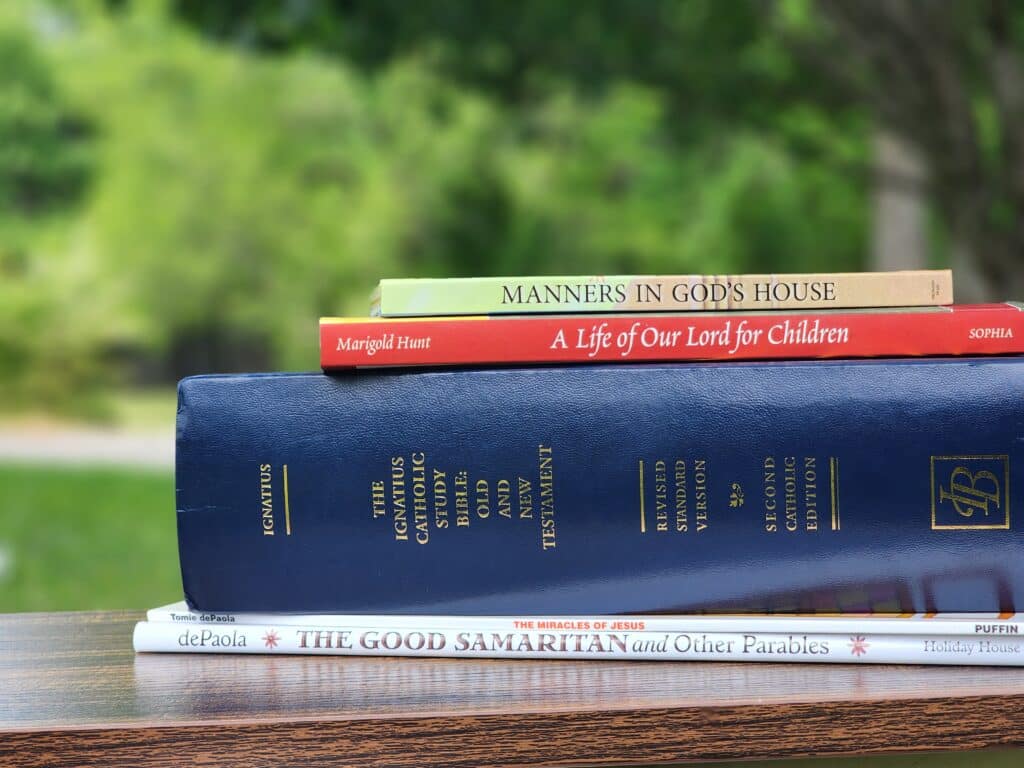
The goal is simple:
To move your child from hearing Bible stories…
to understanding the faith…
to living it within the life of the Church.
One good book at a time. For a complete guide on building a book-based homeschool curriculum, check out our best homeschool books hub.
Table of Contents
How This Catholic Bible Curriculum Works
Most Bible plans fall apart for one simple reason: they try to do too much all at once.
A reading plan, a devotional, a workbook, memory verses, stacked together until it feels overwhelming. And when it gets overwhelming, it gets skipped.
This approach is different.
Instead of stacking everything, this curriculum is built on a simple framework that you rotate through naturally as your child grows. It’s designed to reflect how the faith is actually lived in a Catholic home, not as a single subject, but as something woven into daily life.
This plan focuses heavily on ‘living books’—a concept championed by Charlotte Mason and preserved in digital archives like the Baldwin Online Children’s Literature Project.
The 4 Layers of Catholic Learning
At every stage, your child is engaging with the Bible in four different ways:
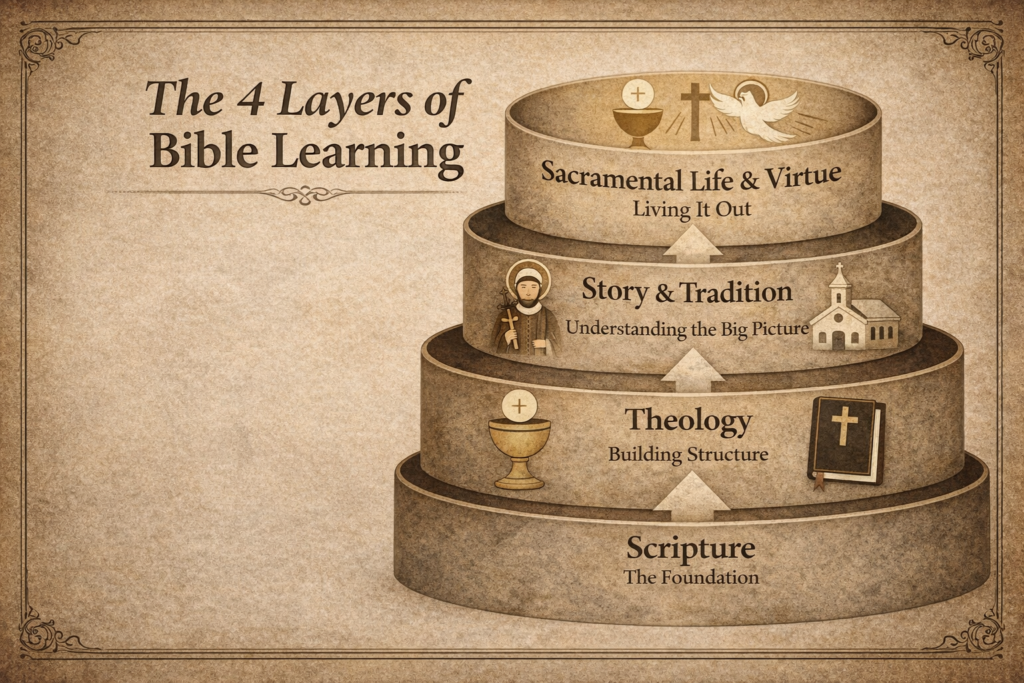
1. Scripture (The Foundation)
This is the center. Even when you’re using story Bibles or supporting books, the goal is always to move toward reading and understanding Scripture itself.
At first, that might look like a few verses read aloud. Later, it becomes independent reading and discussion. But in a Catholic home, Scripture is never isolated. It’s always read within the life of the Church.
2. Story & Tradition (Understanding the Big Picture)
Children don’t just need Bible stories. They need to understand the full story of God’s work in the world.
That includes:
- The story of Scripture
- The lives of the saints
- The history of the Church
This is where kids begin to see that the faith didn’t appear out of nowhere. It has been lived, protected, and passed down over time.
3. Theology (Building Structure)
As kids get older, they need clear answers to the questions they’re already starting to ask:
Who is God?
What is sin?
Why do we need Jesus?
What does the Church teach—and why?
In a Catholic framework, this means drawing from the consistent teaching of the Church as outlined in the Catechism of the Catholic Church. This layer turns scattered knowledge into something that actually makes sense.
4. Sacramental Life & Virtue (Living It Out)
Finally, we want kids to do something with what they’re learning.
In a Catholic home, that naturally includes:
- Participating in the Mass
- Preparing for and receiving the Sacraments
- Practicing virtue in everyday life
This is where faith becomes visible. Not just something we talk about, but something we live.
Rotate, Don’t Stack
Here’s the key that makes this work: You are not doing all four layers every day.
Most days, you’ll read from the daily Lecto Divina and discuss it. Other days, you’ll read from a catechism or read a saint’s story. You don’t have to necessarily do everything.
That’s enough. No need to make it complicated.
What This Looks Like in Real Life
For most families, Bible time looks something like this:
- Add one supporting book (catechism, saints, or devotional)
- Read a short passage or story
- Have a quick conversation
- Move on with your day
Then move on with your day. This fits naturally into:
- Morning Time
- A Morning Basket
- After breakfast
- Before bed
No complicated schedule required.
If you have multiple ages, focus on one main idea each day. Older kids can go deeper, while younger kids engage at their level through stories or simple discussion. The liturgical year works great as an anchor.
Keep It Short (This Matters More Than You Think)
You don’t need long lessons.
- Ages 3–5 → 5–10 minutes
- Ages 6–10 → 10–15 minutes
- Ages 10+ → 15–30 minutes
Consistency matters far more than length. Aim for understanding, not just checking a subject off your list. If your child understands a subject in the first two minutes, you’re done! No need to artificially stretch it out.
The Goal
The goal isn’t to “cover the Bible.” It’s to guide your child through a clear progression:
from loving Bible stories → to understanding the faith→ to thinking about it clearly→ to living it within the life of the church.
When you keep that progression in mind, everything else becomes much simpler. Here’s a quick view of what that looks like:
| Stage | Age | Core Books | What You’re Actually Doing | Goal |
|---|---|---|---|---|
| Stage 1 | 3–5 | Miracles of Jesus, New Catholic Children’s Bible | Reading simple stories, building familiarity, introducing Mass and basic language | Recognize Jesus, Mary, and the rhythm of the faith |
| Stage 2 | 6–9 | New Catholic Picture Bible, A Life of Our Lord for Children, Faith and Life 1–3 | Adding structure, answering basic “why” questions, connecting stories together | Understand the basic story of the faith and what we do at Mass |
| Stage 3 | 10–12 | Acts of the Apostles for Children, Faith and Life 4–5, saint biographies | Connecting Scripture to Church history, introducing theology, applying virtue | See how everything fits together and begin thinking about faith personally |
| Stage 4 | 13–15 | Ignatius Study Bible (Gospels), Faith and Life 6–8, Introduction to Catholicism | Reading Scripture directly, engaging harder questions, exploring real-world faith | Take ownership of beliefs and wrestle with them honestly |
| Stage 5 | 15+ | Bible in a Year, Catechism in a Year, spiritual classics | Building habits (Scripture, prayer), independent reading, deeper theology | Live the faith independently and continue formation beyond home |
Stage 1: Ages 3-5
At this stage, Bible time should feel warm, simple, and familiar.
You’re not trying to “teach theology.” You’re helping your child begin to recognize the shape of the faith: who God is, who Jesus is, and that this is something your family returns to regularly.
If you build that rhythm now, you’ve done more than enough. For most families, you only need one main book at this stage.
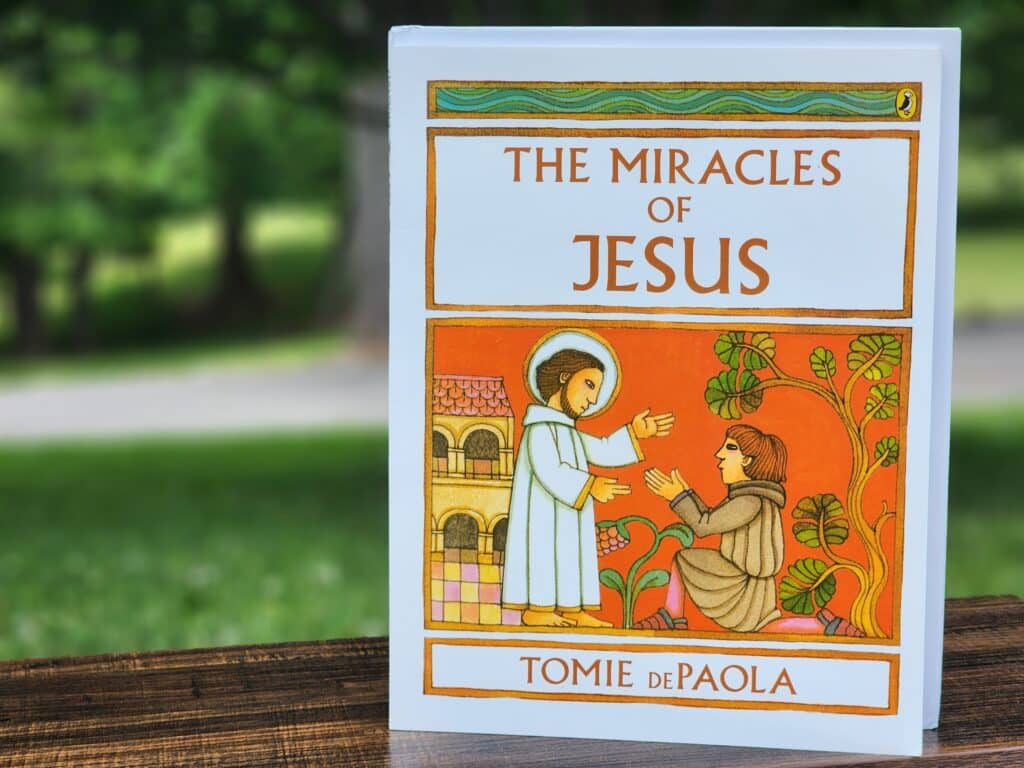
The Miracles of Jesus by Tomie dePaola
Core
This is one of the easiest ways to introduce who Jesus is beyond just “He’s in the Bible.” The stories are short, clear, and very repeatable, which is exactly what you want at this age.
We used this more than I expected, especially during seasons like Lent when I wanted something focused but still simple. It works well to read one miracle at a time and move on. No need to explain everything. Just know that this is simplified. It’s not trying to teach theology. It’s helping your child recognize that Jesus acts, heals, and intervenes.
If you already have a strong story Bible that covers miracles well, you could skip this. But it’s a very easy add if you want something more focused.
A Is for Altar, B Is for Bible by Judith Lang Main
This is more of a “flip-through” book than a read-aloud. It introduces basic Catholic vocabulary and objects your child will see at Mass, which helps more than you might expect. Kids recognize things faster when they’ve seen them before.
We don’t sit down and read this straight through. It’s more something we pick up occasionally or let kids look at on their own.
Think of this as exposure, not instruction.
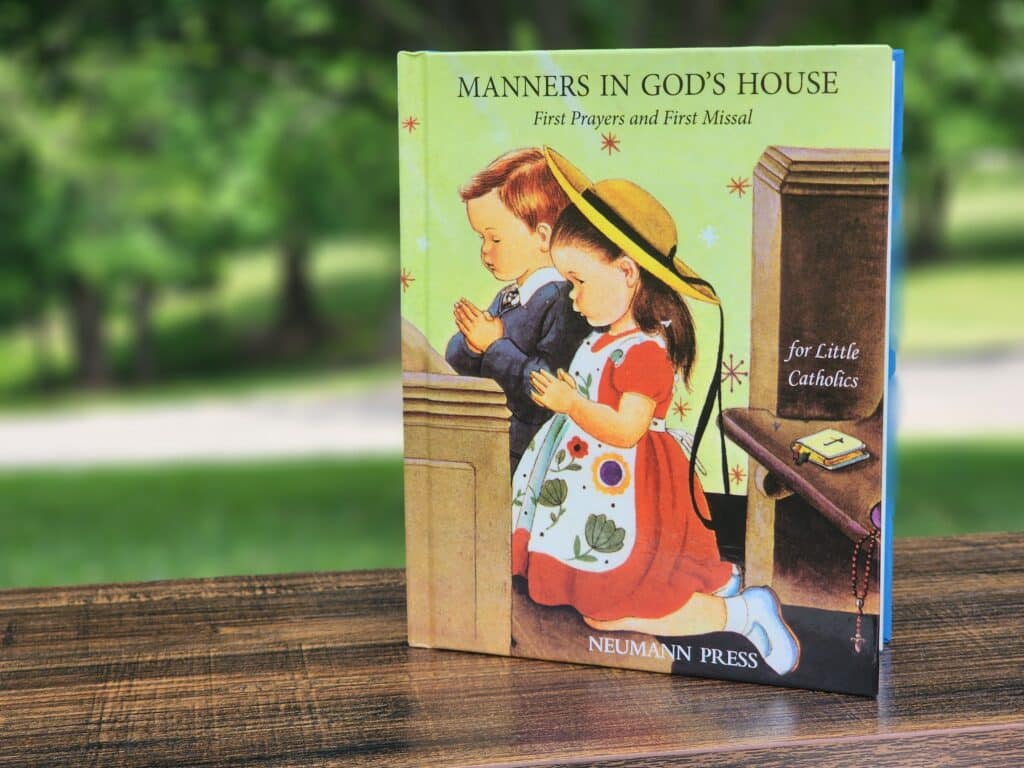
Manners in God’s House: First Prayers and First Missal
This one leans more traditional, and that’s actually part of the appeal. It clearly communicates that Mass is different. That it matters. That there’s a way to behave in that space.
We’ve found it works best before Mass, and we read it with plenty of repetition. It’s much easier to set expectations ahead of time than to correct behavior in the pew.
Some families will love the tone. Others might find it a bit formal. It really depends on what you’re going for.
My See and Pray Missal
It helps kids see what’s happening during Mass, especially the parts that are hard to follow from the pew. The illustrations are based on the Extraordinary Form, but the structure still translates well.
We mainly use this during those quiet moments before Mass starts or when attention starts to drift. It gives kids something meaningful to focus on without pulling them out of what’s happening. If you only use this at home, you’re missing the point. This is a “bring to Mass” book. It’s great for kids who just have to do something during Mass.
Mary: The Mother of Jesus by Tomie dePaola
It introduces Mary in a way that feels calm and familiar, not overly formal or overly simplified. That balance is harder to find than you’d think.
We tend to pull this out during Advent and Christmas, but it doesn’t feel seasonal. It fits just as well on a random Tuesday. Over time, your child starts to recognize Mary naturally, which is really the goal at this stage.
It doesn’t explain everything about Mary, and it shouldn’t. It just places her where she belongs in the story.
Little Acts of Grace by Rosemarie Gortler
This is a good bridge between “Bible time” and actual daily life. It focuses on small, practical ways kids can live out their faith, which is helpful when everything else still feels abstract. It’s much more “doing” and less “learning.”
We don’t use this on a schedule. It works better when something comes up naturally, and you want a quick, concrete way to connect it back to faith.
If your days already feel full, this is easy to skip. But it’s a nice addition if you want something that connects behavior and belief without turning it into a lecture.
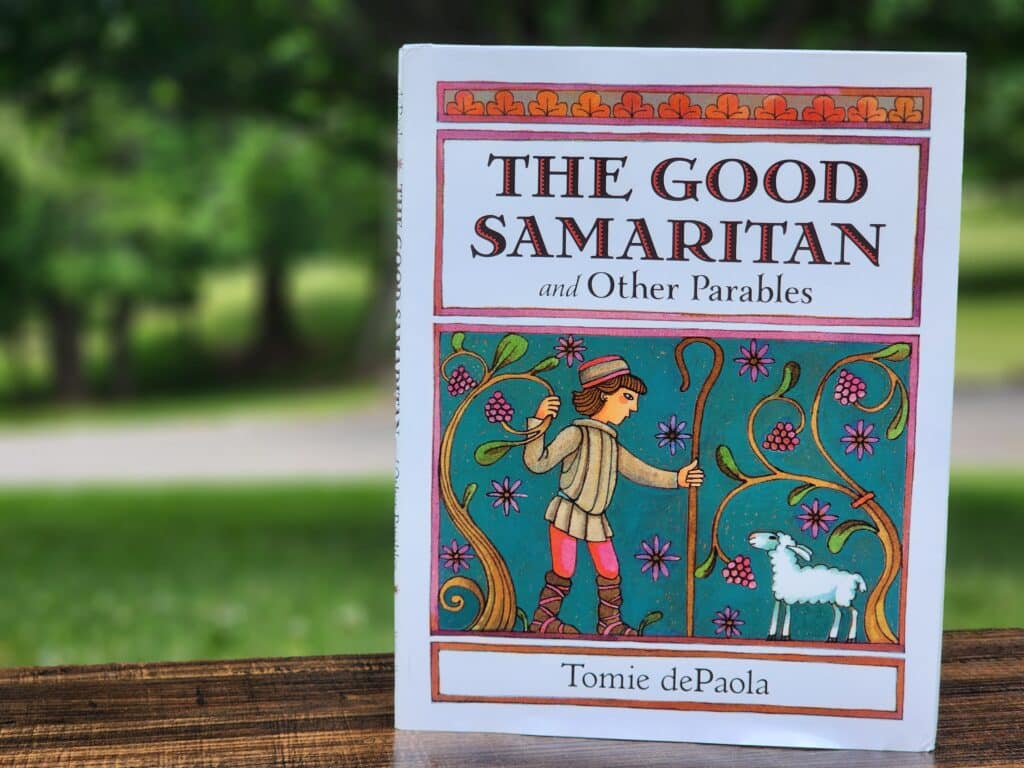
The Parables of Jesus by Tomie dePaola
Parables are surprisingly tricky for young kids, and this version makes them actually usable.
The stories are short and clear without over-explaining, which is exactly what you want. Your child probably won’t fully understand them at first, and that’s fine. This is a book that works better through repetition than explanation.
If your child is on the younger side of this stage, you could wait a bit. This tends to land better closer to age five. However, this stage is all about familiarity, so introducing it earlier won’t hurt, either.
The Mass Book for Children by Rosemary Gortler and Donna Piscitelli
This is a helpful way to explain what’s actually happening during Mass. It walks through the parts clearly without overwhelming detail, which is exactly what most kids need.
We’ve used this more outside of Mass than during. It works well as preparation or a follow-up when kids start asking questions. It’s not a replacement for being at Mass. It just helps connect the dots.
New Catholic Children’s Bible by Fr. Thomas J. Donaghy
Core
If you want a bit more structure, this is a good option. The “two stories a week” approach is manageable and gives you a simple rhythm without overcomplicating things.
We’ve used this during more consistent seasons as my children get older. It’s great for the “in-between time” when your children aren’t quite ready for formal study but are beyond preschool. It helps keep things moving without feeling heavy. Just don’t push it too hard. It should still feel like reading together, not school.
Speak, Lord, I Am Listening: A Rosary Book by Christine Haapala
This is a gentle introduction to the Rosary that actually works for younger kids. Going one mystery at a time is key here. There’s no benefit to rushing it.
We use this slowly, usually pairing it with our prayer rhythm rather than treating it like a separate subject. It works best when it feels natural.
This isn’t a daily book, but it is something you return to regularly.
How to Use This Stage
Keep it simple. One short story a day is enough. Once you finish one book, just move on to the next one. Many books in this section can be re-read (and often teach better when they are).
That might look like:
- A Bible story in the morning
- A saint story before bed
- Or just a few pages on the couch when it fits
Some days you’ll read a full story. Some days, only a few pages. It still works.
Let your child interrupt, ask questions, or just listen quietly. You don’t need to correct or explain everything. You’re building recognition, not mastery. If your child starts to recognize names like Mary, Jesus, or a few of the saints, and associates them with something good and familiar, you’re exactly where you want to be.
That’s the foundation on which everything else will be built.
Stage 2: Ages 6-9
This stage is for kids who already know some Bible stories and are ready to start seeing how they fit together.
They begin to recognize patterns. They notice when names repeat. They start asking simple “why” questions. This is also when faith starts to become a little more personal.
For many families, this overlaps with preparation for First Communion. You don’t need to force that into your reading time, but it’s helpful to begin gently reinforcing what they’re already experiencing at church.
You’re still keeping things simple. But now, you’re starting to add a little structure.
New Catholic Picture Bible
Core
This becomes your anchor book for more structure and in-depth study. This is the first time your children will really begin formal study of the Bible, and this resource works great because it is clear and structured.
We use it most days, reading just one story at a time and moving on. It’s simple and requires zero planning to use. You don’t need to explain everything. Let the repetition do the work. When you finish it, move on to another book and restart this one later.
If you’re juggling multiple ages, this makes it that much easier. Younger kids can listen, and older kids can start connecting things.
Catholic Encyclopedia for Children (OSV)
Kids at this age will start asking tons of extra questions. What is a saint? What is a sacrament? Why do we do that at Mass? That’s why you need this book.
It isn’t something you’ll read straight through. Instead, keep it nearby for when questions pop up. It’s more of a reference book than a read-aloud, and you can use it for many years ahead. It helps answer your child’s questions without over-explaining anything.
If your child isn’t asking many questions yet, you may not use this much. But once they start, it’s incredibly helpful to have on hand.
Faith and Life 1: Our Heavenly Father
This is where you start adding a bit of structure. This book introduces basic teachings in a clear, straightforward way without feeling overwhelming. It gives names and categories to things your child is already starting to notice.
We use this slowly. One lesson at a time, no pressure to move quickly. Some days we read it, some days we skip it.
If you push this too hard, it starts to feel like school. If you go slowly, it becomes a helpful framework. If you already have a catechism you like, use that instead. The goal is structure, not a specific brand.
If you are looking for more structured lesson plans to pair with these readings, many families find success using the formal guides provided by Catholic Heritage Curricula.
Once Upon a Time Saints by Ethel Pochocki
This book (and its sequel) covers the saints for this age. The stories are simple, but they stick. Don’t necessarily treat this book as a “lesson.” Put it in your read-aloud pile instead of your “Bible study” pile.
At this stage, kids start remembering names and stories more clearly, which is where these really start to pay off. Re-read it regularly.
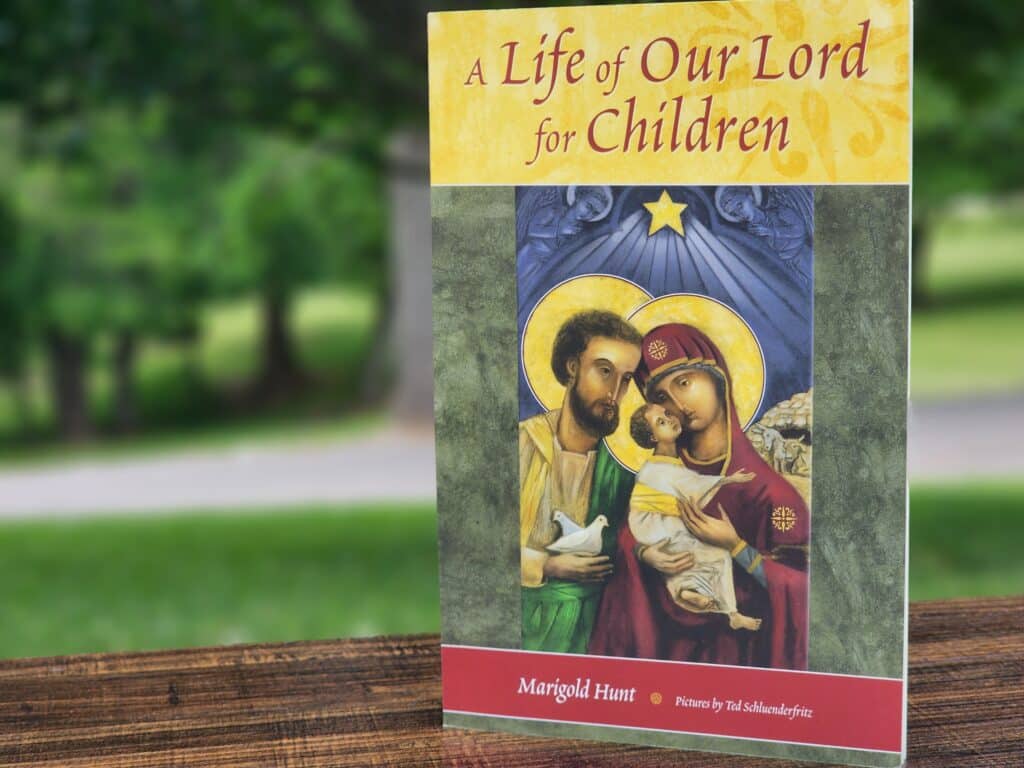
A Life of Our Lord for Children by Marigold Hunt
Core
This is where the story of Jesus starts to feel more complete.
It reads more like a continuous narrative than a collection of short stories, which helps kids start seeing how everything connects. We don’t rush this book. A few pages at a time is enough. It’s better slow.
This works really well after your picture Bible. One gives structure, the other gives flow. If your child is ready for something a little deeper but not overwhelming, this is a great next step.
Jesus Our Life (Faith and Life 2) & Our Life with Jesus (Faith and Life 3)
These build naturally on the first catechism book. They start connecting belief to practice more clearly, especially as kids approach First Communion age.
We don’t use all of these at once. Move into them slowly as your child is ready. These work best when paired with real-life experience, especially going to Mass regularly. Without that, they can feel a bit abstract.
If your child is preparing for the sacraments, these become much more useful.
The Way of the Cross: A Story of Padre Pio by Claire Jordon Mohan
This book introduces sacrifice and suffering in a way that kids can understand. The story of Padre Pio gives a concrete example of what that looks like.
We tend to bring this out during Lent. It fits naturally there, and kids are more receptive to it in that season. Some parts may prompt questions, which is a good thing. You don’t need to answer everything perfectly.
This is a good “stretch” book for this stage. Not daily reading, but worth including.
The Young Life of St. Faustina by Claire Jordon Mohan
This pairs well with the Padre Pio book, but has a slightly different tone.
It introduces mercy in a very personal, approachable way. Kids tend to connect with that quickly. We use this occasionally, not on a schedule. It works best when it comes up naturally or during seasons like Divine Mercy Sunday.
Like most saint books, it’s simplified. That’s fine. The goal is familiarity, not full understanding.
If your child connects with it, it’s worth revisiting later.
How to Use This Stage
At this stage, you’re still keeping things simple, but now there’s a bit more structure.
Most days, you’ll read from your main Bible (like the New Catholic Picture Bible), then rotate in something else when it makes sense. That might be a catechism lesson, a saint story, or a section from A Life of Our Lord for Children. You don’t need to stack them.
A simple rhythm works well: Bible reading most days & catichism or a saint story a few times a week.
When you finish one book, simply move on to the next one! When you reach the end of the list, start back at the beginning. With consistent reading, you’ll likely go through this list several times.
This fits easily into a morning basket, after breakfast, or even just a few minutes before starting your day. It doesn’t need a formal block. Your child should start developing a more concrete sense of the Catholic faith, but these studies work best when they’re just something you do, not another subject to check off.
Supporting books are often necessary at this age because of questions. Your child might start to ask questions like “Who is this person?” and “Why do we do this?” Those questions can fuel further study that doesn’t necessarily function on a specific timeline. Feel free to stop and explore your childrens’ questions whenever they pop up.
You don’t need perfect answers. You just need to take the question seriously and follow it a little further.
At this stage, progress looks like:
- Recognizing familiar names and stories
- Starting to connect ideas across readings
- Understanding that what they hear at Mass connects to what they read at home
If your child is doing that, you’re doing exactly what you need to.
Stage 3: 10-12
Up to this point, your child has heard stories and started recognizing key figures and themes. Around this age, they’re ready for more structure. They want to know not just what happened, but what it means and how it all fits together.
This is also when faith starts to become more personal.
Kids at this age are capable of understanding cause and effect, patterns, and basic theology. They’re also starting to notice the connection between what they read at home and what happens at Mass. You don’t need to turn this into a formal theology class. But this is the right time to introduce more complete narratives and church history.
Your goal here is to move from a scattered understanding to a more connected understanding of the faith.
The First Christians: The Acts of the Apostles for Children by Marigold Hunt
Core
This is one of the most important books at this stage. Up until now, most kids think the story ends with Jesus. This book shows that it doesn’t. It continues through the early Church.
We read this slowly, just a few pages at a time. The chapters are long, so do not try to read a whole chapter at a time! It pairs well with what they’re hearing at Mass, especially as they start recognizing names like Peter and Paul.
If you want your child to understand that the Church didn’t just appear later, this is a key piece.
Speak, Lord, I Am Listening by Christine Haapala
We used this book in stage 1, but it plays a different role here. Kids are more capable of sitting with the mysteries of the Rosary now, even if they don’t fully understand them. The reflections start to land more deeply.
One mystery at a time is enough. Re-use this book as necessary.
This works best when it’s tied into your actual prayer life, not treated like a separate subject. Use it to explain the rosary while you teach your children how to pray.
57 Stories of Saints by Anne Eileen Heffernan
More saint stories! At this age, kids will start remembering details and connecting more deeply to the strains. They start to notice patterns and compare stories. This book will introduce them to a wide range of stories without aiming for “completeness”.
You can use this after the rosary book above, as just another book in your cycle. It’s also a great way to follow the liturgical calendar if you want to, but it doesn’t have to be structured that way.
Saint Helena and the True Cross by Louis De Wohl
I love using saint stories as independent readings at this age, so the next few books will be exactly that.
This is a great introduction to Church history through a single story. It shows how the early Church preserved and honored what came before, which helps kids understand continuity.
Saint Dominic and the Rosary by Catherine Beebe
This connects directly to a practice your child is already learning. It helps answer the natural question: “Where did the Rosary come from?”
We like pairing this with actual Rosary time. That connection makes it stick much more than reading it on its own.
Saint Joan: The Girl Soldier by Louis De Wohl
This one tends to grab attention right away.
It introduces courage and obedience in a way that feels very real to kids. There’s enough action here to keep them engaged, but also plenty to talk about.
Expect questions. That’s part of the value.
St. Thomas More of London by Elizabeth Ince
This is one of the clearest examples of standing firm in your faith. Kids may not grasp all the political context, but they understand the core idea: choosing what is right even when it costs you something.
While this book absolutely functions as an independent read, I still recommend touching base regularly.
Florence Nightingale’s Nuns by Emmeline Garnett
This book provides a clear example of how faith connects with service. It shows that living your faith doesn’t always look dramatic. Sometimes, it’s quiet, consistent care for others.
It’s a good balance to more intense martyr stories.
Jesus Our Guide (Faith and Life 4) & Credo: I Believe (Faith and Life 5)
Continue this series of theology books, which we introduced previously. If you are brand new, start with Faith and Life 1 and move through them in order. They’re worth leaving out some other books to get through.
These books start answering questions more clearly and giving structure to things your child has probably already started to pick up. Do one lesson at a time until you’ve finished, and consider re-visiting these after you’ve made it through all the books on this list.
My Path to Heaven by Geoffrey Bliss
This book takes many of the more abstract concepts at this age and makes them more practical. It focuses on virtue in a way that kids can apply. It works best as an endcap to this age in preparation for the next one.
This book is really more about formation than information.
The Way of the Cross by Inos Biffi
This is a more mature look at the Station of the Cross, making it a solid option for Lent. Kids can begin understanding sacrifice more completely at this age, and this book helps guide them there.
Slower is absolutely better for this book.
How to Use This Stage
This stage is largely about balance. You want to bring together scripture, tradition, teaching, and lived examples. I try to hit on all of those considerations in this list to ensure a more well-rounded education.
You do not have to do everything at once. In fact, I don’t recommend it. Instead, I recommend simply working through this list, reading books one-by-one. When you reach the end, start the list over until your child is old enough to move on.
Keep many of these books as read-alouds to work through with your kid. However, the saint books can be assigned as independent reading alongside your shared reading.
At this age, conversation becomes especially important. Leave room open for discussion after reading every book. You don’t need perfect discussion points, just a shared interest in the faith.
You can look things up together, go back to Scripture, or simply pause and come back to it later. At this stage, you’re also teaching them where to find information, which can be just as important as what the information is.
Don’t try to cover everything. Instead, your goal is to introduce the church as a part of history, explain what we believe and why, and begin connecting faith to real choices. These books cover all of that.
Stage 4: 13-15
Now, your child is starting to wrestle with their faith, not just learn about it. Questions begin to get sharper:
- “Do I actually believe this?”
- “Why does the Church teach that?”
- “Does this matter in real life?”
Don’t consider this a problem to solve. Questions are absolutely normal and a sign your child is starting to adopt their faith as their own, not just parroting off information. Your goal is to give your teen strong sources, real examples, and plenty of discussion time.
This stage should include direct engagement with scripture, clear teaching from the Church, and real-life examples of lived faith. Your goal is simple: help your teen take ownership of their faith.
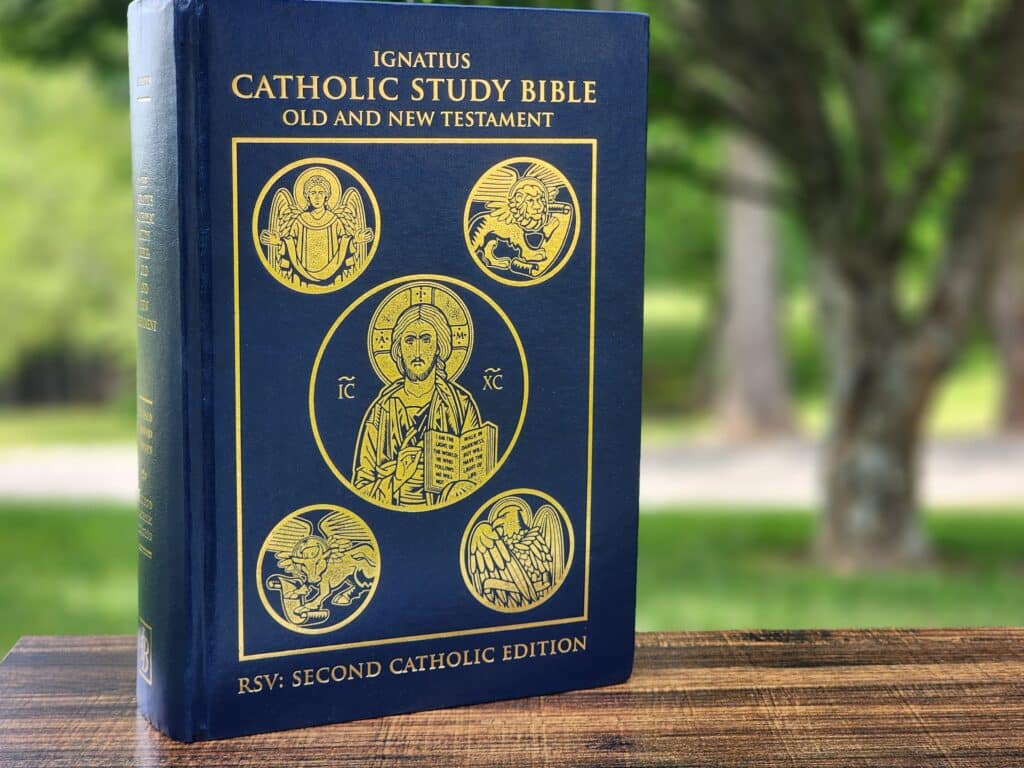
Ignatius Study Bible (Read the Entire Gospels)
Core
At this age, your teen should be reading the Gospels directly, not just summaries. The study notes help without overwhelming.
Don’t rush this. A short passage at a time is enough. If you only do this in the next three years, you will have made sizable progress. I actually recommend doing this alongside other books in this list. Consider this your “always” reading, and work through the other books as usual.
Encourage your teen to ask questions and sit with them. You don’t need to turn every reading into a discussion. The goal is familiarity and confidence in reading Scripture itself.
Bible History by Ignatius Schuster
This helps connect everything into a timeline. Many teens know these stories, but they don’t really understand how everything works together. This helps fix that issue.
Again, this is best read slowly, one section at a time.
Faith and Life 6 – 8
These books provide structure and answer some of the more pressing questions your teen probably has. They move beyond the basics at this age and start addressing how the faith is actually lived.
Move through these as usual, one less at a time, until you finish them. If your teen is resistant, don’t force it daily. Use these a few times a week instead and use something simpler, like a saint reading, during the other times. Some children just feel with their hearts instead of their heads.
Introduction to Catholicism: A Complete Course
After Faith and Life, use this. It provides a stronger, more complete view of the faith, providing clearer answers. Go through it slowly and discuss it often. It becomes most useful when your teen starts asking bigger questions and is ready to struggle through theological debates.
Story of a Soul by St. Thérèse of Lisieux
This book is one of the more important reads at this age. It shows what real holiness looks like in ordinary life. Some teens will connect deeply with it; others may need to go slowly. Either way, it’s worth reading and discussing.
We recommend reading this together or discussing it as you go.
Little Flowers of St. Francis
This is a lighter read that works great as an independent option. Assign it as you work through tougher books out loud.
It presents virtue through simple stories.
Saint Athanasius by Frances Forbes
This book introduces some real theological conflict to chew on. It shows that faith must be defended and explored over time, which many teens can get behind at this age. Teens probably won’t catch every detail, but that’s fine. This is a great book to revisit later.
What really matters is the core idea: truth matters, and it’s worth defending.
Blessed Miguel Pro: 20th Century Martyr by Ann Ball
This is one of the more engaging saint stories I’ve read, especially at this age. It’s fast-paced and takes place in a much more modern context. I recommend it for any catholic teen, especially reluctant readers who might struggle with the other books on this list.
A Heart for Europe by Joanna Bogle
I recommend this book because it’s much different from other saint books out there. It also ties closely with World War I history. However, it isn’t super action-packed. It’s a slower read, but meaningful. I recommend it as a supplemental book. But if you have to drop something, drop this one.
Children of Fatima by Windeatt
This is a great, practical example of Marian devotion. It helps teens see how real faith can shape real events. It’s a pretty easy read, but the language is a bit more archaic than some of the other books on this list.
Edith Stein: Woman of Prayer by Joanne Mosley
For a more reflective biography, try this one. It works best for teens who are ready for something a bit deeper. Not every teen will connect with it right away, but that’s okay! It’s absolutely worth trying, but if your teen starts dragging through it, feel free to shelf it for later.
The Last Days of Maximilian Kolbe by Sergio C Lorit
This is a powerful example of sacrificial love and lived faith. It’s heavier, but teens are probably ready for it once they reach this point in the list. While I recommend most biographies as independent reading, this is one I recommend reading together. It gains a lot from discussion.
Stories of Padre Pio by Katerina Tangari
After the last two books, this one is a bit easier, but no less important. If your child has been reading through this book list for several years, they’ve probably already know who Padre Pio is, which makes this reading even more straightforward.
It introduces more advanced mysticism, which helps hold many teens’ attention. Expect plenty of questions.
Stories of Karol: The Unknown Life of John Paul II by Gian Franco Svidercoschi
This is a complete biography of Pope John Paul II. Because it’s a more modern book, it feels more accessible than biographies about older Popes. It shows a full life, not just a title. It helps teens really understand what the papacy is about and how it functions in the modern world.
Mother Teresa’s Lessons of Love by Susan Conroy
Mother Teresa is one of the more famous saints, and this book is a first-hand account of her work written by someone who actually worked next to her. It has some tougher scenes in it, but those help to show teens God’s love even better. It’s a pretty easy read, but I did position it later in this list because of some of the challenging content.
The Shepherd Who Didn’t Run by María Ruiz Scaperlanda
One of the best books on modern sacrifice was written about a martyr who was killed in the 1980s. It’s a tough read due to the emotional content, but it’s absolutely worth reading through slowly. Feel free to save it for the very end of this stage if your child is more sensitive, or read through it slowly together.
Boys to Men: The Transforming Power of Virtue by Tim Gray
While this book is written for young men, I highly recommend it for young ladies as well. Each lesson contains a lesson about living virtuously in the modern world. After a series of saint books, this one brings everything down to a more practical level. Use it intentionally and discuss each lesson to get the most out of it.
A Philadelphia Catholic in King James’s Court by Martin de Porres Kennedy
This is a great follow-up if your teen connected with St. Thomas More. It gives a much clearer picture of what it actually looked like to live as a Catholic in a hostile political environment. That’s something teens can start to grasp at this age, especially as they begin noticing cultural tension in their own lives.
That said, this is not the most exciting book on the list. You can skip it if your teen just can’t get through it, but I find it a great example of apologetics in action.
He Leadeth Me by Walter Ciszek
This is one of my favorite books in this whole state. It’s a firsthand account of keeping your faith under extreme suffering, but it doesn’t feel overly dramatic. I would not assign this for independent reading, though. It works much better read together.
Some parts are slow, but don’t rush through them. The value is in sitting with what he’s actually saying about surrender and trust.
We’re On a Mission From God by Mary Beth Bonacci
This is one of the easier reads at this age, but it’s a great book to end this stage with. After several heavier biographies, this brings things back down to a more conversational level. It helps teens connect the idea of “mission” to their actual lives.
I like placing it at the end, when your teen has already read through a few more intense books. It works well as an independent read (perhaps as you read through He Leadeth Me) and doesn’t require tons of discussion.
How to Use This Stage
This stage works best when you stop trying to control everything. Your teen doesn’t need a perfectly balanced plan or a complete checklist of doctrine. They need consistent exposure to Scripture, solid teaching, and real examples of lived faith.
I recommend assigning these three things at a time:
- Consistent scripture reading; try to get through all the Gospels in four years
- A read-together book or catechism teaching (just move down the list)
- An independent book (probably a biography)
You don’t have to do all three every day. You’re perfectly free to read through a gospel, switch to a catechism, and then finish up with a biography. You could even just read through the books in this list in order (though that would load all the “similar” books together; this isn’t necessarily a huge issue).
It’s whatever works for your family. If you have many children, you can assign many of these books (or even nearly all) as independent reading, especially if you emphasize discussions. If you don’t, you might read many of these books together.
The main point is that you should work through this whole list over three years. If you finish early, restart at the beginning. If your teen “ages up” before you finish, wait in this stage a bit longer. It’s worth working through all the books before moving on, even if that means your teen never reaches the next stage.
As always, remain open to questions and skepticism. Many of the saint biographies include miracles, which might raise a lot of questions. That’s the point! You want your teen to start owning their faith now and chewing on the big questions while you’re still around to help and guide.
Stage 5: 15+
This stage is really the handoff of your teen’s religious education. Religious education is a lifelong occupation. At this stage, your job is to guide your teen to take over their own religious education upon graduation.
Up to this point, you’ve guided most of the reading and structure. Now your teen should be taking real ownership. That doesn’t mean they’ll suddenly become consistent or deeply motivated. It means the responsibility starts shifting.
This stage is less about covering material, though I’ll include tons of resources below. The focus should really be about forming habits, like daily scripture readings, personal prayer, and regular mass attendance. Now is the time to introduce your teen to adoration, if you haven’t already.
Your goal is to move them from a guided faith to a self-sustained faith. This means letting them fail sometimes, too.
The Bible in a Year (with Fr. Mike Schmitz)
Core
If you use nothing else in this stage, use this podcast. In fact, if you can, work through it with your teen. The daily format removes decision fatigue, which is one of the biggest obstacles at this age. Just play one podcast episode a day, preferably with your Bible open and ready.
Pair it with the companion if your teen benefits from structure. If not, just stick with the podcast. This works best as a daily habit, not something you “catch up on.” If you miss a day, that’s fine, just keep going! You have three to four years to get through one year, so don’t feel rushed.
The Catechism in a Year (with Fr. Mike Schmitz)
Core
After the Bible in a year, move on to this very helpful podcast by the same person. In it, Fr. Mike Schmitz moves through the whole Church catechism, paragraph by paragraph, explaining everything as he goes. It’s one of the best ways to work through exactly what we believe and why.
Deus Caritas Est by Pope Benedict XVI
This is a great first step into reading actual Church documents. It’s shorter than most encyclicals and very readable. It focuses on love, but in a way that challenges a lot of modern assumptions.
I recommend reading this slowly and discussing it. It’s not difficult, but it does require attention. We’re trying to introduce your teen to this format, so take your time.
Spe Salvi by Pope Benedict XVI
This pairs well with Deus Caritas Est. It focuses on hope, but in a deeper way. This is slightly more abstract, so I wouldn’t start here. Use it after your teen is comfortable reading Church teaching.
Again, go slowly and discuss.
Laudato Si’ by Pope Francis
This is one of the more accessible modern encyclicals. It connects faith to the real world in a very visible way, focusing mostly on responsibility. Teens tend to engage with this text easily because it feels relevant.
Fides et Ratio by Pope John Paul II
This is one of the more challenging books in this section. It deals with faith and reason in a way that requires a lot of deep thinking. If your teen isn’t ready for it yet, wait until closer to graduation. However, after reading the last three books, many teens are ready.
There’s no benefit in forcing this one, but it can be one of the more important books at this stage.
The Confessions by St. Augustine
This is a classic for a reason. It’s personal and surprisingly relatable, even now. That said, it’s not always easy. Some translations are harder than others.
I recommend reading this slowly, and ideally together. It leads to strong discussions if you give it space. If your teen struggles with it, try a different translation before giving up. I’ve linked to my favorite translation below.
The Creed in Slow Motion by Ronald Knox
This is one of the clearest explanations of the Creed I’ve found. It breaks things down without oversimplifying them, which is exactly what you’re aiming for at this age. If your teen still has gaps in understanding what we actually believe, this is a great fix.
The Mass in Slow Motion by Ronald Knox
Same idea, applied to the Mass. Of course, this should be paired with regular attendance at Mass. But it’s a great companion that explains exactly what happens. It’s not a long book, and it doesn’t need to be stretched out. Read it and move on.
Talking with God by François Fénelon
This is a more reflective book after the very practical books above. It focuses on prayer in a direct way, encouraging this very important habit. Not every teen will connect with it right away, but I absolutely recommend still reading it. If necessary, read it with your teen.
On Spiritual Friendship by Aelred of Rievaulx
This is one of the more unique (and important) books on this list. I recommend prioritizing it. It addresses friendship in a serious, thoughtful way, which is incredibly relevant at this age. Teens may not think super in-depth about relationships, but this book will fix that. I recommend reading it and discussing it together.
Searching for and Maintaining Peace by Jacques Philippe
This is one of the more practical books on this list. It deals directly with anxiety, frustration, and interior life in a way that teens can actually apply. In our modern age, anxiety is running absolutely rampant, especially amongst the younger generations. This book is a direct answer to those modern issues.
It’s a great independent read. You don’t need tons of discussion. However, if your teen is struggling, plan to read it alongside them to offer extra support.
Seek That Which Is Above by Joseph Ratzinger
A more reflective book. It works great for teens who are comfortable with deep reading, which they should be at this point. However, if your teen struggles, feel free to save it for later.
This book explains the liturgical year, which is another one of the “habits” we should be looking to support. It also covers other topics, like rest and joy.
The Spiritual Exercises of St. Ignatius of Loyola
I’ll start by admitting that this is not an easy read. It requires real effort. However, it is one of the key frameworks of spiritual development. After covering the basics of the faith, this is where your teen should be heading next.
Don’t assign it as a normal book. Use it intentionally and with plenty of guidance. Encourage your teen to actually practice what is in it, preferably by reading through the book and practicing these things yourself!
The Interior Castle by St. Teresa of Ávila
This is one of the deeper spiritual classics, and one of the hardest to read. However, as your teen approaches the end of their school years, I really encourage them to read it.
That said, this is one of those books that is only impactful if your teen is ready for it. If they aren’t, it’ll be a chore to get through. Consider gifting them a (nice) copy and reading through it together, perhaps during Lent.
The Imitation of Christ by Thomas à Kempis
This classic devotional is a must-read for any teen. Its short sections make it easy to work through regularly. This works well as a daily or near-daily reading. No need to overcomplicate it. Read a section and move on. It’s a fantastic break from the several harder books I just recommended.
The Return of the Prodigal Son by Henri Nouwen
I love this reflective devotional because it is one of the more approachable spiritual books. It makes heavy theology easier to connect with and can help cover some of the gaps your teen might still have a hard time understanding.
It’s a good entry point to more contemplative reading.
Discernment Do’s and Don’ts by Fr. Timothy Gallagher Elliott
Send your child off with this extremely practical book. It helps teens think about decisions, vocation, and direction in a structured way, which is exactly what’s probably on their mind at this age. It helps them get started on their path with the right foot. Read it, discuss it, and point back to it when your teen is making decisions that will impact the rest of their life.
How to Use This Stage
This stage is about ownership and consistency. Your role shifts again, moving from more directive to more supportive. Yes, have a required reading list, but how your teen engages with those books will become more and more personal.
By the end of senior year, your teen should be taking their spiritual formation into their own hands.
Start off with the Bible in a Year podcast. When that is done, move on to the Catechism in a Year podcast. Those two things lay the foundation for everything else.
At the same time, read through one of the other suggested books. Unlike the previous stage, you will rarely have read-together books by this point. When you do, they will replace independent reading, not be done alongside it.
Don’t try to stack multiple books at once. Let your teen move at their own pace. In the spirit of giving them more control, allow them to select their own books when appropriate. If one book on this list stands out, let them read it first! If they see a book they’re interested in that isn’t on this list, let them read that, too.
Some books should be discussed (Confessions, encyclicals). Others can be independent (Imitation of Christ, Philippe).
Progress here should look like reading scripture without prompting and developing a personal prayer life. If your teen is engaging consistently, even imperfectly, you’ve done your job.
Do not make this stage about finishing this list. Make it about your teen building a faith they can carry on their own.
Why You Can Trust This List
This isn’t a theoretical book list.
These are books we’ve actually used in our home, across multiple ages, adjusting as our kids grew and their questions changed. Some of these became favorites we’ve read more than once. Others worked well for a season and then got set aside. That’s normal.
We didn’t choose these books because they looked good on a list or ranked well on Amazon. We chose them because they lead to real conversations.
We also paid close attention to how these books fit together over time. One of the biggest problems with most “Christian booklists” is that they don’t build. They repeat the same ideas at different ages without helping kids move forward. They’re just choosing the best books, not creating a system for actual learning.
This list is different. Each stage is meant to do something specific. If you follow it loosely and stay consistent, your child won’t just hear Bible stories. They’ll start to understand the faith and eventually take ownership of it.
You don’t need to use every book here. You don’t need to follow it perfectly. But this is a path that works.
How to Use These Catholic Homeschool Books
Okay, so you have the list, but now what?
Step 1: Start Small
Find your child’s age group and purchase one core book from that section. That’s the very first book listed in each section (look for the “core” label).
That’s it. If you’re between stages, go with the easier option. You can always move up later. A lot of the “easier” books are just as heart-changing as the “more advanced” options.
Don’t try to map out the whole year (this keeps the curriculum more personalized). Don’t buy every book on the list.
For most families, your core book is your Bible reading (or story Bible for younger kids). The extra books can be added after you find a good routine.
Step 2: Add One Supporting Book
Once your routine feels normal, add one more book. Not three or five or “one for each category.” Just one. That will probably be a catchism or a saint book.
I recommend just picking the second or third book listed for your child’s stage – the first book that isn’t listed as “core.” Then read it a few times a week in addition to your core book. When you get done with it, move on to the next one.
Step 3: Keep a Simple Rhythm
You don’t need a strict schedule or lesson plans. Instead, read your core book almost every day and your supporting book a few times a week. Once something is finished, move on to the next thing. Go as slow or as fast as you need to. Discuss as yoru child asks questions, or you feel prompted to explain.
Do not lesson plan or try to come up with discussion questions. I find that this actually stifles discussion. What you think your child should get out of a lesson probably isn’t what they’ll actually get out of this. That’s okay. Discuss the parts they find interesting or confusing. That’s what it means to personalize a curriculum.
Step 4: Just Do The Next Thing
You don’t need a complicated weekly schedule here. Instead, just open up your core book every day and do the next thing.
For younger kids still reading out of a story Bible, you just read one chapter each day, discuss, and move on. No need to plan ahead or even look at what you’re doing beforehand. This simplicity is why this plan works so well, even for busy moms.
Once your child is older, the same principle applies: read a chapter from the core book, discuss, and move to the next one tomorrow. That said, feel free to break up harder readings into smaller portions. Watch your child’s stamina.
After a book is finished, move on to the next book in your child’s age group. If you finish a stage, either move onto the next one or re-read the books from the beginning, depending on your child’s age. All of the books on this list deserve a second reading if you have time for it.
You’ll know your child is ready for the next stage when they start asking deeper questions or seem ready for more independence. The key is not to rush each stage. You aren’t trying to “get through” anything. You’re building hearts.
Practical Advice
Here are some random tips from my several years of homeschooling:
- Let the questions lead. Your main teaching will occur through discussions, not just reading. The reading provides the information to discuss, but the discussions are where true growth occurs. You don’t need perfect answers to every question, but you do need to be open to discussion.
- Don’t treat every book the same. Every book is not the same, so you shouldn’t treat them the same! Some books will be used daily for a year or more, while others will be read through once. Your child might need to slow down at one particular point, but they may quickly absorb another book in a week.
- Remain flexible. One of the perks of homeschooling is the ability to personalize your child’s curriculum. However, you lose that if you try to stick to a particular schedule or book list. That’s one reason I don’t recommend all-in-one, boxed curricula – you lose this flexibility. Don’t let this book list turn into an unmovable source you can’t edit. Instead, if a book feels like a struggle, swap it out or come back later. Let your child read books that aren’t on this list.
- Don’t “try to finish.” You’re not trying to finish every book. You’re trying to build familiarity with scripture, introduce church teachings, and create space for real conversations. Sometimes, you will read through a whole stage and restart it. At other times, you might skip several books when your child ages up to the next stage.
- Keep the goal in mind. Your goal is to raise kids who recognize scripture, understand what the church teaches, and know how to keep going on their own. You are not trying to raise kids who have “completed a curriculum.”
What to Skip
Most people assume they need everything on this list. Every book. Every stage. A full plan mapped out in advance. You don’t. If you’re feeling overwhelmed, you can safely skip:
- You don’t need every book at once: Each stage is built around a few strong options, not a checklist. Start with one core book. Add one more if things are going well. Just keep reading until you reach the bottom of the list. Done.
- You don’t need a formal curriculum: Don’t bring all the downsides of public school into your homeschool by trying to make your child fit a one-size-fits-all curriculum.
- You don’t need a perfect schedule: You don’t need to assign days, rotate subjects, or “cover” certain material each week. Just open the book and do the next thing.
- You don’t need to explain everything: Your child will not understand everything the first time through. That’s not a problem. Re-reading, hearing the same stories again, and asking questions later does far more than trying to explain every detail upfront.
- You don’t need to finish every book: In fact, feel free to throw books in the trash that you just can’t stand.
- You don’t need to rush through the stages: If your child is enjoying a stage, stay there. If they’re asking deeper questions, move forward. You don’t need to match a timeline exactly. This works best when it grows with your child, not ahead of them.
What really matters is reading about catholicism regularly and keeping room open for questions. That’s the whole system.
Frequently Asked Questions
Do I need to buy every book in this curriculum?
No. Most families will only use one or two books at a time. Start with a core book for your child’s stage and add another if you feel like you need it.
This isn’t meant to be a checklist. It’s a framework you can grow into over time.
What if my child isn’t interested in Bible time?
This is more common than most people admit. If it starts to feel like a struggle, pull back. Shorten the time, switch to a more engaging book (like a story Bible or illustrated version), or move Bible time to a different part of the day.
Consistency matters, but forcing it usually backfires. A shorter, positive experience is far more effective than a long, frustrating one.
When should my child start reading the Bible independently?
Most kids are ready to begin around ages 8–10, but it doesn’t need to be a hard transition.
Start small:
- A few verses at a time
- Reading together when needed
- Letting them take the lead gradually
The goal isn’t independence overnight.
What if we fall behind or skip days?
Since all you’re going to do is “the next thing” every day, there really isn’t such a thing as “behind.” Just pick up where you left off and keep going. You don’t need to finish each book in each stage before moving on, and you don’t need to move to the next stage right “on time.”
Whenever your child “ages up,” finish the book you’re on, then start the core book for the next stage.
What are the best Christian homeschool books by age?
The best Christian homeschool books vary by developmental stage. Preschoolers thrive on simple, story-based Bible books. Elementary students benefit from saint biographies and worldview-building stories. Middle schoolers are ready for deeper discussions and light apologetics, while high schoolers can engage with theology, philosophy, and cultural analysis.
Organizing books by age helps you stretch your child gently without overwhelming them.
Do I need a Christian curriculum to homeschool my child in faith?
Not necessarily.
Many families build a strong Christian homeschool using carefully chosen books alongside core academic resources. A literature-rich approach allows faith to be woven naturally into history, science, and daily discussion rather than confined to a single subject block.
Books often shape a worldview more deeply than scripted programs.
Are Christian homeschool books only for religious families?
Most of the titles on this list are written from a Christian worldview and are best suited for families who want faith integrated into daily learning. However, many saint biographies, historical accounts, and worldview discussions can still be valuable for broader cultural understanding.
It depends on your goals and philosophy.
How do I choose Christian books that aren’t overly preachy?
Look for books that show faith lived out in real situations rather than delivering constant moral commentary. Stories that allow characters to struggle, grow, and wrestle with truth often feel more authentic than books that spell out every lesson.
A good Christian homeschool book should spark conversation, not shut it down.
Can Christian books replace Bible study in homeschool?
They shouldn’t replace Scripture, but they can deepen understanding.
Christian biographies, apologetics, and worldview books help students see how biblical truth applies in history, science, culture, and daily life. Many families pair these titles with regular Bible reading or devotionals for balance.
How many Christian books should we read each year?
There’s no required number.
Some families rotate one Christian read-aloud at a time. Others integrate faith-based books into history or literature studies throughout the year. Consistency matters more than quantity. A few thoughtful books read deeply often have more impact than rushing through many.
What are good Christian books for teens wrestling with doubt?
For teens asking hard questions, apologetics titles like those by Lee Strobel, Nancy Pearcey, or C.S. Lewis can be helpful. Books that acknowledge struggle, rather than pretending faith is simple, often resonate most deeply.
Encourage discussion and create space for questions. That matters more than having every answer ready.
Bottom line
You don’t need a complicated Bible curriculum to raise kids who understand their faith.
You need a clear progression: from saint stories to understanding to theology to real ownership. And a handful of books that support that along the way. Read Scripture regularly, add in good teaching and real-life examples, and let conversations happen naturally. That’s what builds understanding over time.
If you keep showing up, even imperfectly, you’re doing the work that matters. A child who learns to return to Scripture, ask honest questions, and stay connected to the life of the Church is already on the path to a steady, lived faith.
For building out other homeschool subjects using the best books, check out our best homeschool books guide, which goes through every subject.
Author Note
We’ve used many of these books in our own home over the years, across different ages and stages.
Some became favorites we came back to again and again. Others worked well for a season and then faded out as our kids grew. That’s normal, and it’s part of why this guide is structured the way it is. This isn’t about finding the perfect curriculum and sticking to it forever. It’s about having a clear path and using good books to support it.
If something here works for your family, keep it. If it doesn’t, adjust and move on.
As an Amazon affiliate, we may earn commission (at no extra cost to you) on the links above.