We may earn affiliate income (at no extra cost to you) on the links below.
Have you ever opened a history textbook with your kids and watched their eyes glaze over? You’re not alone.
History should be one of the most engaging subjects we teach. It’s full of real people, high-stakes decisions, strange cultures, wars, discoveries, and moments that shaped the world we’re living in right now. But somehow, it often gets reduced to timelines, bullet points, and facts that disappear as soon as the test is over.
That’s what I think of as the “textbook trap.” Lots of information. Very little retention. Almost no connection.
Over the years, we’ve moved almost entirely away from that approach. Instead of relying on one rigid curriculum, we’ve built our history studies around books: real, narrative, living books that tell the story of the past in a way kids can actually follow and remember.
Because here’s what I’ve seen over and over again:
- Kids remember stories, not summaries
- They connect with people, not dates
- And once they care about what they’re reading, everything else gets easier
That doesn’t mean you need a complicated system or a perfect plan. In our home, history is built on a pretty simple idea: A few books help you see the big picture. The rest help you feel what it was like to live there. We read widely, we revisit time periods as kids grow, and we let good books do most of the heavy lifting.
Table of Contents
Quick Start: Best History Books by Era & Age
If you’re feeling overwhelmed, start here:
- Pick one era
- Choose 1–2 books for your child’s age
- Read them slowly and talk about them
| Era | Ages 6–9 | Ages 10–13 | Ages 13+ | Why These Work |
|---|---|---|---|---|
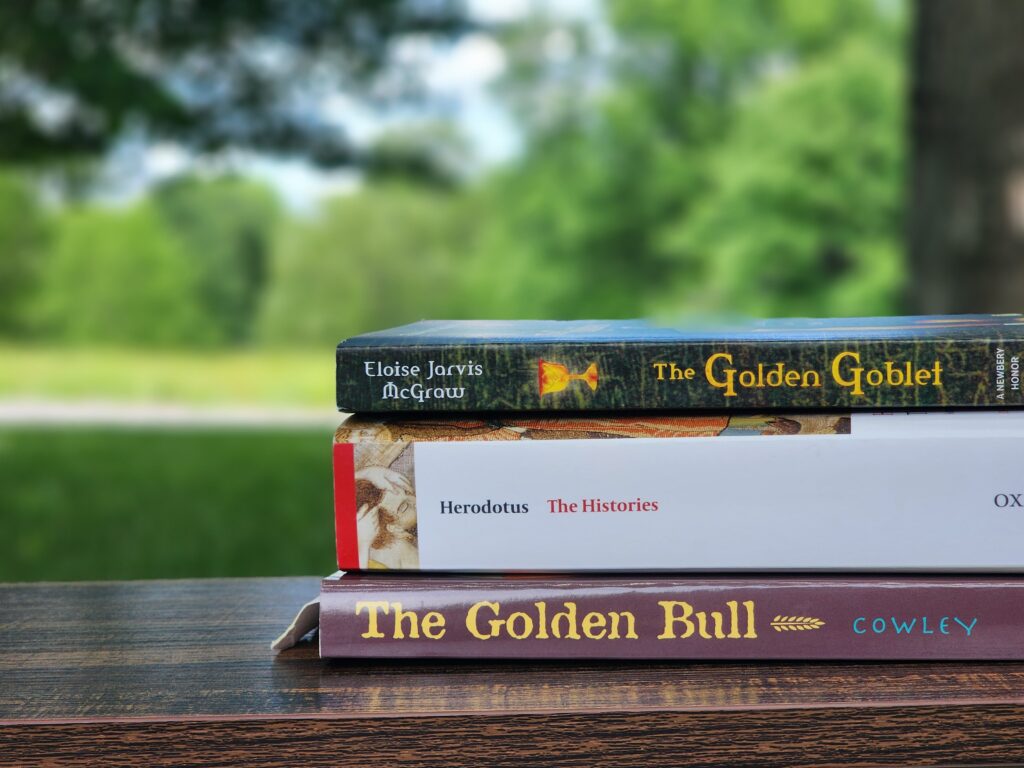
| Ancient History | The Golden Bull The Golden Goblet | The Story of the Greeks Augustus Caesar’s World | The Odyssey The Histories | Builds a strong timeline and introduces foundational cultures through story |
| Middle Ages & Renaissance | Viking Tales Castle | The Door in the WallCrispin | The World of Columbus and Sons Voices of the Renaissance | Shows how the world rebuilt and how new ideas began to spread |
| Early America | Squanto’s Journey George vs. George | Johnny Tremain The American Revolution | The Autobiography of Benjamin Franklin A Tale of Two Cities | Helps kids understand how a nation forms through real people and decisions |
| Modern History | Snow Treasure A Boy Named FDR | Number the Stars Across Five Aprils | The Killer Angels Night | Connects history to the modern world through high-stakes, human stories |
How This Guide Is Organized
This page is designed to be a starting point, not an overwhelming list.
You’ll find history organized into four major eras:
- Ancient History (early civilizations through Rome)
- Middle Ages & Renaissance
- Exploration & Early America
- Modern History
Within each section, I’ve highlighted a small set of starter books for each age group:
- Ages 6–9
- Ages 10–13
- Ages 13+
These are the books I’d reach for first if I were building a history plan from scratch. Then, if you want more options (and I always do), you can click through to the full, detailed booklists for each era.
A Quick Note on My Approach
You don’t need to cover everything in one year. You don’t need to follow a strict curriculum. And you definitely don’t need to assign a worksheet for every chapter.
Most families naturally cycle through history over time, coming back to the same eras again and again, each time with a deeper understanding. Younger kids absorb stories, and middle-grade students start seeing cause and effect. Older students wrestle with ideas, consequences, and worldview. It’s this layering that makes history stick.
If you’re looking for a way to teach history that feels more alive, more connected, and honestly more enjoyable for both you and your kids, this is a great place to start.
How To Use This List
This is a big guide. It’s meant to be. But you don’t need to use all of it. If you’re just getting started, here’s the simplest way to approach it:
Step 1: Pick a Time Period
Choose one era (Ancient, Medieval, Early America, or Modern) and stay there for a while. You don’t need to jump around.
Step 2: Start with a Few Books
Each section in this guide includes my top picks for each time period. It isn’t all the books I like, but it is the ones that help you see the “big picture.” I highly recommend starting with these and then adding more.
If you only read 3 to 5 books per era and talk about them a little, you’re doing more than enough.
Step 3: Add More
If your kids are engaged and curious, that’s when you add more:
- extra biographies
- historical fiction
- “daily life” books
- rabbit trails
I include links to my favorite extras in each section. So, if you really want to dive deep, make sure to visit those articles. If not, just use the books in this one.
A Quick Note on the “History Cycle”
You’ll often hear about a 4-year history cycle, and it’s a helpful idea, but don’t overthink it.
The basic concept is:
- Year 1: Ancient History
- Year 2: Middle Ages
- Year 3: Early America
- Year 4: Modern History
Then you repeat. All your kids should preferably be doing the same cycle, even if that means some start in the middle. This makes it easier for you and allows everyone to discuss what they’re learning.
Don’t feel like you need to cover everything, either. You only need a handful of great books and a clear timeline.
Let’s walk through the best homeschool books by era now.
🏺Ancient History Books (Creation to the Fall of Rome)
If you’re not sure where to start with history, this is it.
Ancient history lays the groundwork for everything that comes after: governments, philosophy, science, religion, and even the way we tell stories. It’s also one of the easiest places to hook kids, because the material is naturally engaging. After all, who doesn’t want to learn about pyramids, heroes, and empires?
Of course, there is a lot here. But you don’t need to cover it all at once. At this age, the goal is simple: Help your child build a mental timeline of the ancient world and connect it to real people and places.
Young readers (ages 6-9)
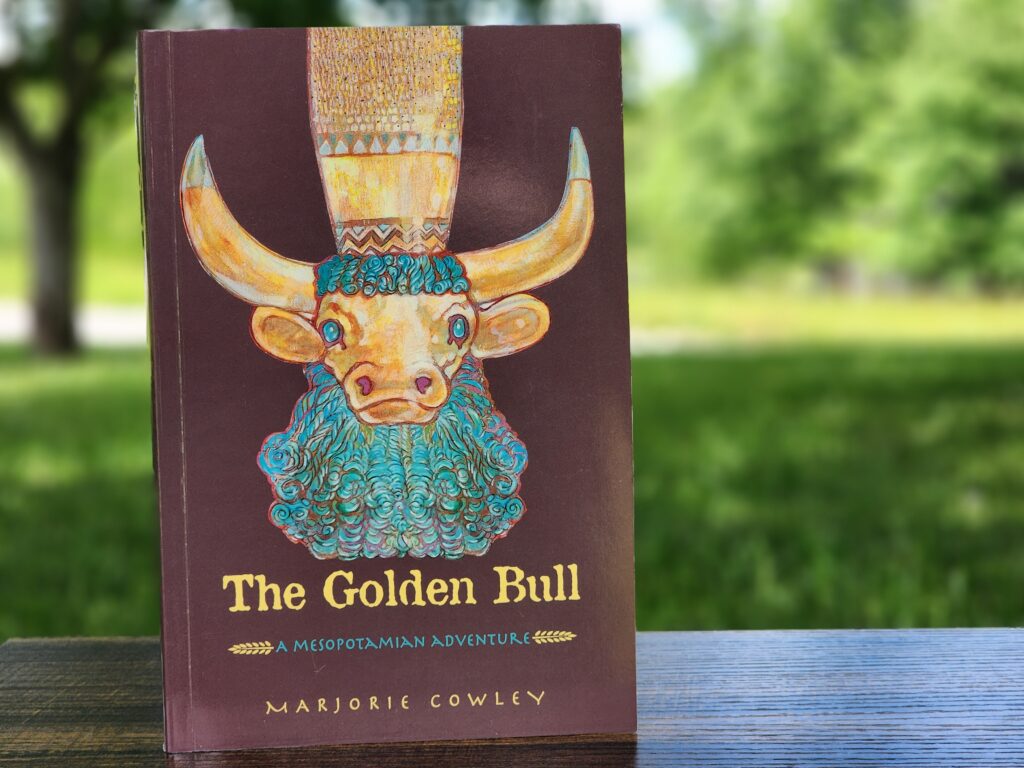
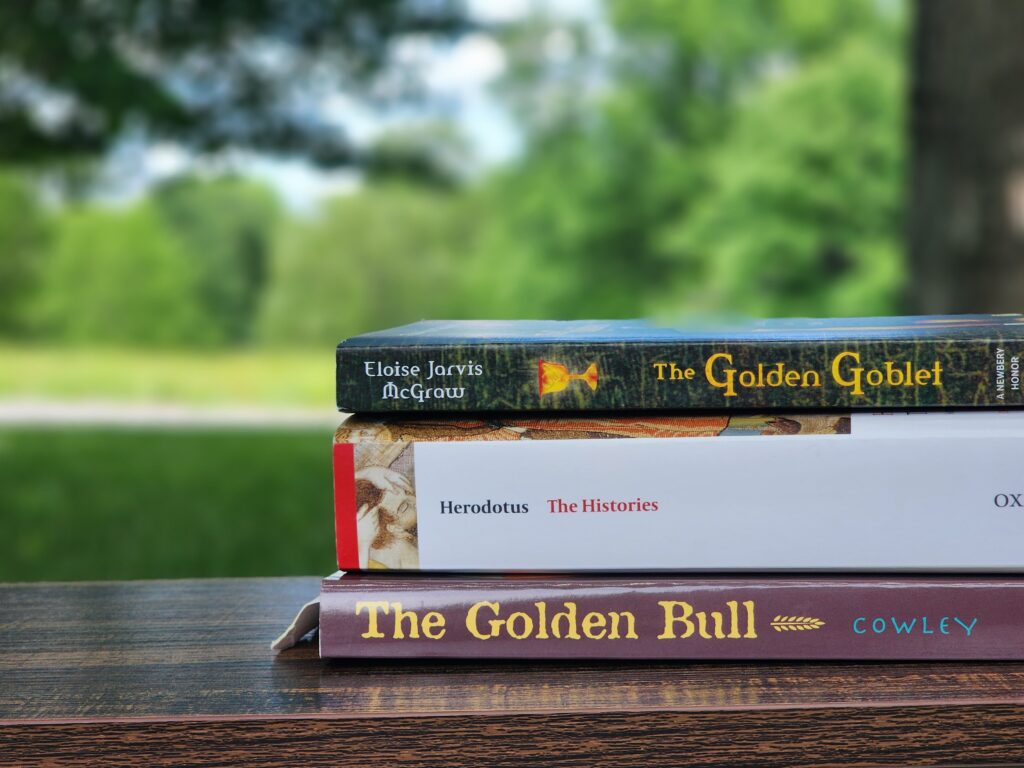
The Golden Bull by Marjorie Cowley
This is one of the few truly narrative books set in ancient Mesopotamia, which is a time period most homeschool plans quietly skip. It follows a boy through everyday life, which makes an unfamiliar civilization feel approachable. I like this one because it fills a real gap and gives kids a sense of what life actually looked like in one of the world’s earliest cultures.
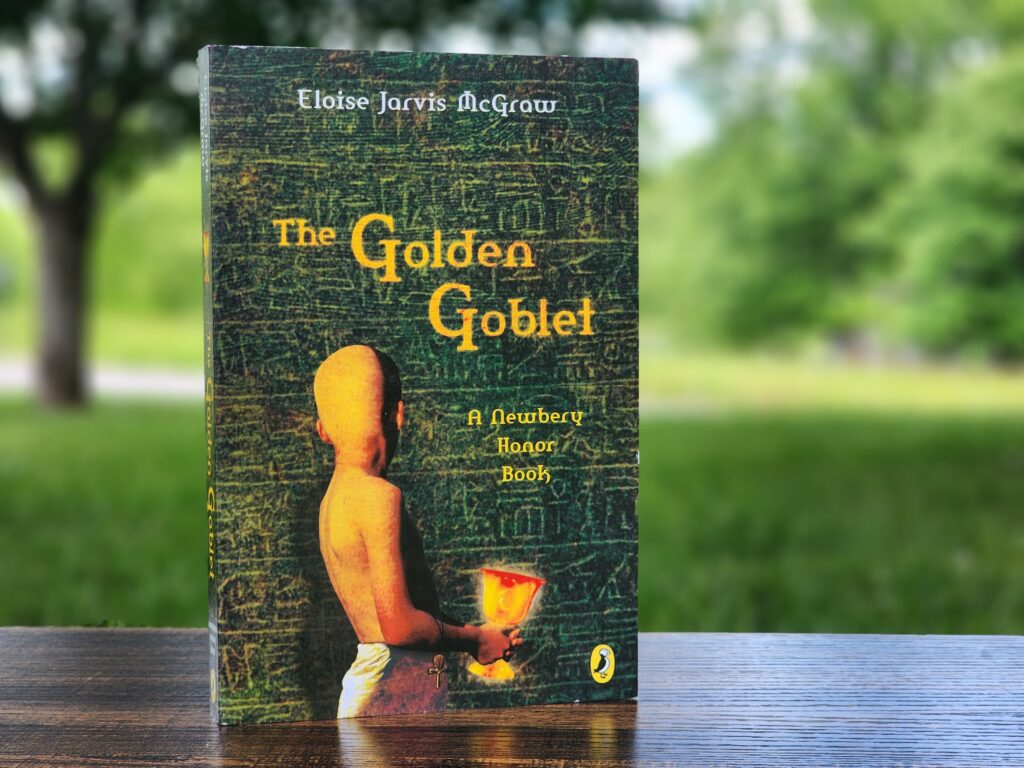
The Golden Goblet by Eloise Jarvis McGraw
If you only read one Egypt book at this age, make it this one. The story is compelling enough to pull kids along, but it’s packed with details about craftsmanship, apprenticeships, and daily routines. We picked it because it makes ancient Egypt feel lived-in, not just something with pyramids and pharaohs.
Our Little Athenian Cousin of Long Ago by Julia Darrow Cowles
Told through a child’s eyes, this one pulls kids straight into daily life in ancient Athens — the markets, the games, the festivals. When we read it, my 8-year-old kept stopping me to compare their chores to her own (the ultimate compliment, honestly). The story is gentle and warm, with enough adventure to keep a younger listener hooked. It’s perfect for children who love character-driven stories and want to feel what history was like, not just memorize facts.
Middle readers (ages 10-13)
The Story of the Greeks by H. A. Guerber
This has been a steady favorite in classical and Charlotte Mason circles for generations because it works: short chapters, clear narrative, and enough myth woven in to keep kids engaged. When we used it, my kids picked up the “big arc” of Greek history almost without realizing it. If you want an easy-to-follow overview that ties people, culture, and ideas together, this makes a strong backbone for an ancient Greece unit study.
Augustus Caesar’s World by Genevieve Foster
If I could only pick one book for this entire era, this would be it. Instead of focusing on just Rome, it shows what was happening across the world at the same time. That “horizontal history” approach helps kids understand that civilizations weren’t isolated. They were developing alongside each other. It’s one of the fastest ways to build real historical context.
The Bronze Bow by Elizabeth George Speare
This brings the Roman world, and especially the time of Jesus, into focus through a personal story. It’s emotional without being overwhelming, and it gives kids a sense of tension, culture, and daily life under Roman rule. We chose it because it connects history to something familiar and meaningful in a way that sticks.
Older Readers (ages 13+)
The Odyssey by Homer
Once your teen is ready to take the plunge into Homer, this is where the ancient world suddenly feels alive. Reading it aloud turns the poem into something powerful and surprisingly approachable. Consider using it during a unit on virtue and perseverance, and the conversations were some of our richest. Perfect for older kids who are ready to engage with big themes head-on.
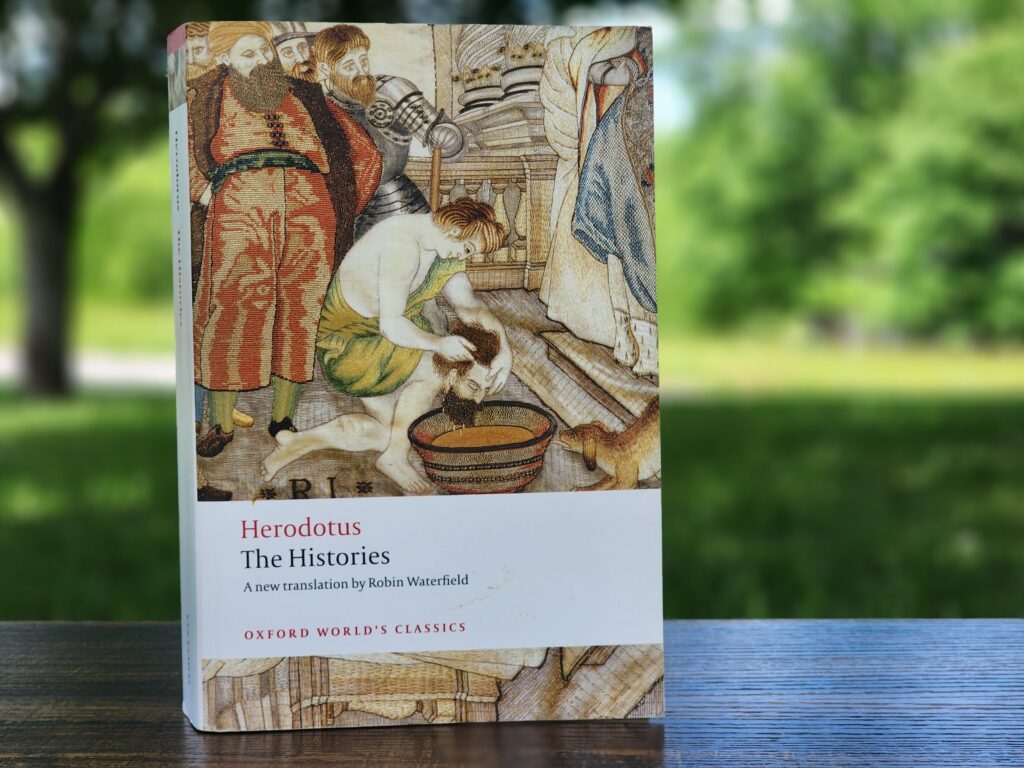
The Histories by Herodotus
This is not a “read it straight through” book in most homes, and that’s okay. Even reading selections gives students a sense of how early historians understood the world. It’s messy, curious, and sometimes strange, which is exactly why it’s valuable. It shows how history was first recorded and interpreted. It’s the history of history.
SPQR by Mary Beard
This is one of the clearest, most readable overviews of Rome for older students. It helps tie together everything they’ve encountered—government, expansion, culture, and decline—into a more complete picture. We picked it because it bridges the gap between story-based learning and real historical analysis.
Want the Full List?
If you want more options, including additional fiction, biographies, and books that fill in smaller gaps like China, you can explore the full list here: Complete Ancient History Booklist
🏰 Middle Ages & Renaissance Books
Rome is gone. Kingdoms form. The Church shapes daily life. Trade routes stretch farther than most people realize. And slowly the world begins to change again through art, science, and exploration. This is one of my favorite sections of history, and there are tons of good books out there covering it.
But, for many families, this era can feel a little scattered. So, here’s a quick goal for this age: Help your child see how the world was rebuilt after Rome and how new ideas started to take hold.
That goal is your guiding light. Don’t try to cover everything. Just cover that story.
Younger readers (ages 6-9)
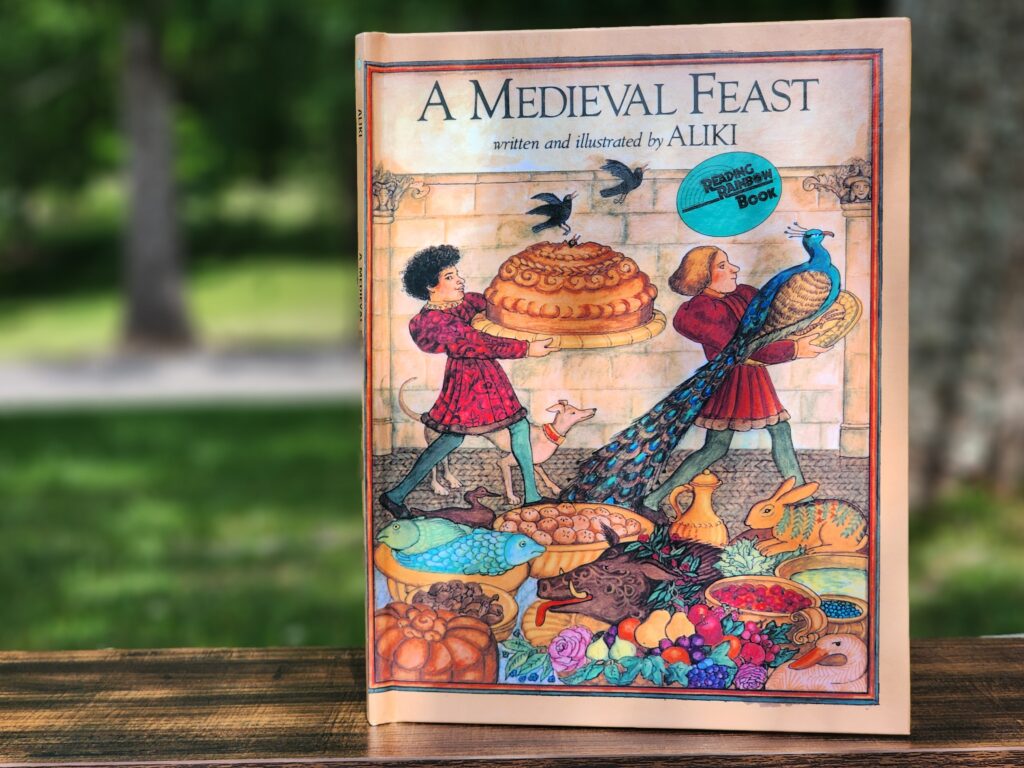
A Medieval Feast by Aliki
This one is always a hit with younger kids. Aliki somehow makes roasting peacocks and preparing for the king feel both hilarious and fascinating. My 6-year-old loved spotting all the tiny details in the illustrations, and it sparked so many questions about chores and food in medieval times. It’s a gentle, story-based way to introduce the Middle Ages without overwhelming them with facts.
Read it more than once!
Castle by David Macaulay
If you have a visual learner, this is gold. The step-by-step breakdown of how a castle is built makes everything else make more sense: why walls mattered, how people lived, how defense worked. My kids lingered on these pages longer than almost anything else we read. It’s a book to take slowly and really look through.
Viking Tales by Jennie Hall
This is one of the easiest entry points into the early Middle Ages. It reads like a story, but it introduces exploration, culture, and the idea that history didn’t just happen in one place. We used this as a read-aloud, and it immediately made the time period feel bigger than “just castles.”
Middle readers (ages 10-13)
The Inquisitor’s Tale by Adam Gidwitz
This Canterbury-Tales-style adventure is quirky, thoughtful, and surprisingly deep. Gidwitz handles big topics like courage, faith, and tolerance with warmth and humor, which led to some truly great conversations in our house. Tweens especially appreciate the shifting narrators and the blend of folklore and philosophy. A standout modern “living book.”
The Door in the Wall by Marguerite de Angeli
This is a quiet book, but it sticks. It’s set during the time of the Black Death, and it shows resilience, faith, and daily life without being heavy-handed. We chose it because it gives emotional context to a time period that can otherwise feel abstract.
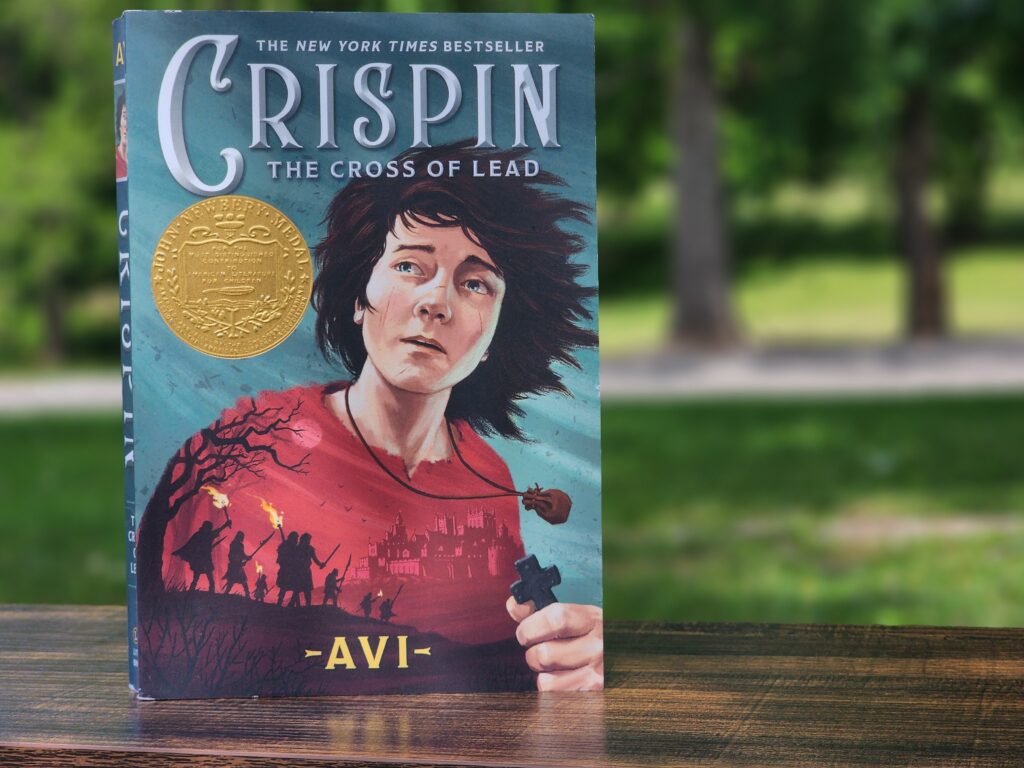
Crispin: The Cross of Lead by Avi
This one pulls kids straight into medieval England. It’s fast-paced, a little tense, and full of real historical texture, like guilds, social classes, and travel. My kids got completely pulled into the story, which is exactly what you want at this age. It’s faster than The Door in the Wall, making it a good book to read next.
Older readers (ages 13+)
A World Lit Only by Fire by William Manchester
This one helps explain why the Middle Ages felt so different and what changed during the Renaissance. It’s not something you rush through, but it gives clarity to a time period that can otherwise feel confusing. I like it because it connects the dots.
Voices of the Renaissance and Reformation, edited by Rob Shearer
Primary sources can be intimidating, but this anthology makes them feel approachable. Teens get direct excerpts from letters, speeches, and essays, all framed with helpful context. Great for sharpening critical thinking and understanding how ideas actually moved across Europe.
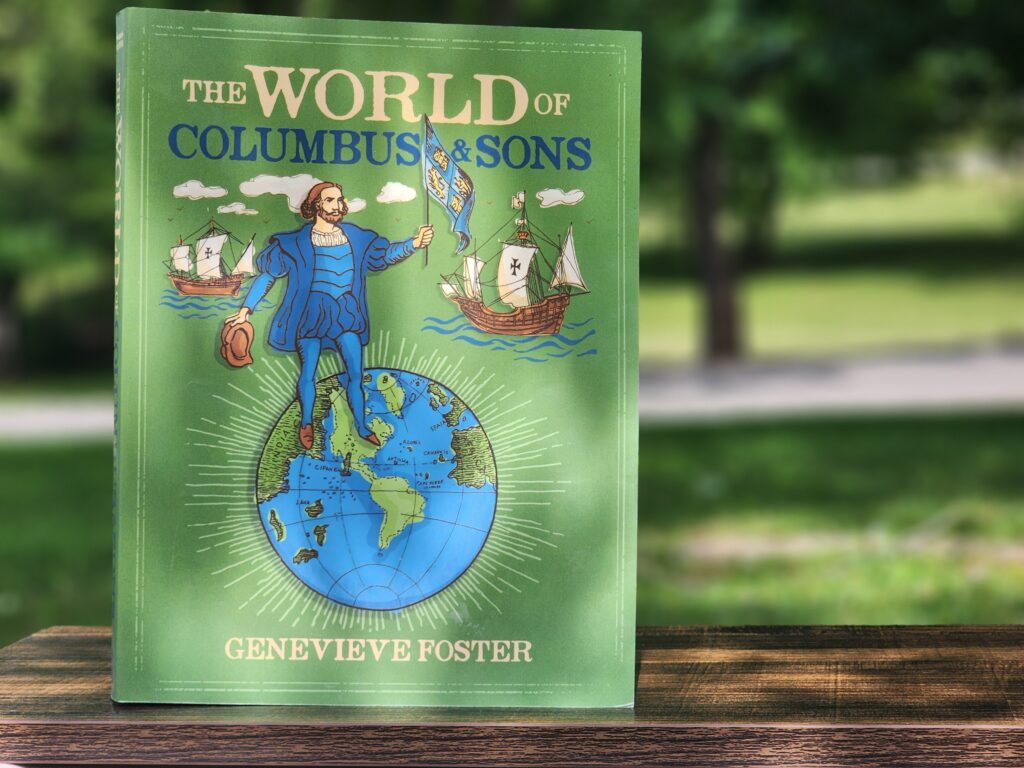
The World of Columbus and Sons by Genevieve Foster
Foster’s books are always worth including. This one shows what was happening across the world during the age of exploration, which helps students understand that these events weren’t isolated. It’s one of the easiest ways to build global awareness.
Want the Full List?
If you want more options, including additional historical fiction, biographies, and books that fill in smaller gaps, you can explore the full list here: Complete Middle Ages & Renaissance booklist.
🧭 Exploration & Early America Homeschool Books
This is where you move from distant civilizations into people crossing oceans, new cultures meeting, colonies forming, and a nation being built. It’s also one of the easiest eras to teach. There are just so many strong narrative books here.
The challenge isn’t finding material. It’s narrowing down your options! So, the goal for this stage is simple: Help your child understand how America formed, and the people and decisions that shaped it.
Younger readers (ages 6-9)
Squanto’s Journey by Joseph Bruchac
This is one of the most balanced introductions to early America I’ve found for younger kids. It doesn’t oversimplify, but it also doesn’t overwhelm. My kids asked more questions during this one than almost any other early American book, which is exactly what you want.
The Cabin Faced West by Jean Fritz
This is such a cozy, grounded look at frontier life. It doesn’t try to cover everything. Instead, it shows what daily life actually felt like for a family moving west. We picked it because it helps kids feel the setting, not just learn about it.
George vs. George by Rosalyn Schanzer
This is one of the best first introductions to the Revolutionary War. It shows both sides clearly, which helps kids understand that history isn’t just “good guys vs. bad guys.” It’s simple, readable, and gives a solid foundation without getting overwhelming.
Middle readers (ages 10-123)
Johnny Tremain by Esther Hoskins Forbes
This is one of those books that just works. It drops kids right into the Revolutionary War era through a character they actually care about. My kids stayed engaged the whole way through, which isn’t always guaranteed at this age.
Amos Fortune, Free Man by Elizabeth Yates
This book adds something many lists miss: depth and perspective. It follows a man’s life from enslavement to freedom, and it opens the door to meaningful conversations without feeling overwhelming. We used it slowly, and it led to some really good discussions. It’s very important that you set aside plenty of discussion time for this book.
The American Revolution (Landmark Books)
This is where things start to come together. The Landmark books are clear, narrative-driven, and just structured enough to give kids a sense of the full story. We use this as a “tie it all together” book after reading fiction.
Older readers (13+)
The Autobiography of Benjamin Franklin
Franklin’s humor and self-reflection make this surprisingly lively for a primary source. It’s one of the best upper-level reads for connecting character, curiosity, innovation, and early American history. I found it works well when read slowly and discussed in sections — Franklin gives plenty to chew on.
America: The Last Best Hope, Volume 1 by William J. Bennett
If you want a clear, readable overview of early American history, this is one of the easiest options. It connects events into a continuous story, which helps everything make more sense.
A Tale of Two Cities by Charles Dickens
This one covers the French Revolution. It’s an important world history topic that also touches a bit on American History. It also introduces bigger themes like justice and sacrifice that older students are ready to wrestle with.
Want the Full List?
If you want more options, including additional historical fiction, biographies, and books that fill in smaller gaps, you can explore the full list here: Complete Early American History booklist.
🚂 Modern History Homeschool Books
This is where history starts to feel closer to home. You move into industrialization, the Civil War, world wars, civil rights, and modern problems.
This era can also feel very heavy. So, pacing is important. You don’t need to cover all the details, especially at an early age. The goal is: Help your child understand how the modern world took shape, and how people lived through it.
Younger readers (ages 6-9)
Meet Abraham Lincoln (Landmark Books)
This is a gentle entry point into the Civil War era. It doesn’t try to explain everything. Instead, it introduces Lincoln as a person first. That makes it much easier to build on later.
Snow Treasure by Marie McSwigan
This is one of the easiest ways to introduce World War II without overwhelming younger kids. It’s fast-paced, a little suspenseful, and based on a true story. My kids were completely hooked and didn’t even realize how much history they were absorbing.
A Boy Named FDR by Kathleen Krull
Krull makes Franklin Roosevelt’s childhood struggles feel real and relatable. My kids were surprised to learn how many challenges he faced long before he became president. It’s uplifting without sugarcoating and fits nicely into Great Depression units or leadership studies.
Middle readers (ages 10-13)
Number the Stars by Lois Lowry
If you only read one Holocaust-related book at this age, make it this one. It’s clear, accessible, and deeply moving without being overwhelming. My kids connected immediately with the characters, which made the history feel real.
Across Five Aprils by Irene Hunt
This is one of the best Civil War books for middle grades. It shows the war from the perspective of a family, which helps kids understand how complicated and personal it was. We read this slowly and talked through it. It’s worth taking your time.
Hidden Figures (Young Readers Edition) by Margot Lee Shetterly
This adaptation does an excellent job of celebrating the brilliance of Black women mathematicians who helped send astronauts into space. It’s inspiring and full of real history, amazing for civil-rights units, space studies, or STEM encouragement.
Older readers (ages 13+)
The Killer Angels by Michael Shaara
This is one of the most engaging Civil War books I’ve seen for teens. It brings leaders, decisions, and consequences into sharp focus. It’s not light reading, but it’s incredibly effective for understanding how the war unfolded.
The rest of the Civil War Trilogy is also good, so read it too if you have time.
Night by Elie Wiesel
This is a difficult book, but an important one. It gives a firsthand account of the Holocaust in a way that no summary ever could. We approach this slowly and with discussion, but it leaves a lasting impact. If your teen enjoyed this book, feel free to continue with the trilogy.
I Am Malala by Malala Yousafzai
This helps bridge history into the present. It shows how global issues like education, rights, and conflict are still unfolding today. It’s readable and a good reminder that history isn’t finished. Great introduction to modern politics without being too divisive, too.
Want the Full List?
If you want more options, you can explore the full list here: Complete Modern History Booklist.
Choosing Books by Age
If you’ve ever wondered, “Is this book too much for my child?”—you’re not alone.
Age ranges help, but they’re not exact. Reading level, sensitivity, and attention span all matter just as much. What I’ve found most helpful is thinking in stages, not strict grades.
Here’s how that looks in real life:
Ages 6–9: Build Interest First
At this stage, history should feel like storytime, not school. You want your children to connect to characters and see the overall flow of history, not necessarily memorize dates.
Focus on:
- short, engaging narratives
- strong visuals
- everyday life (what people ate, wore, built)
What works well:
- picture books
- simple chapter books
- read-alouds you can stop and talk about
What doesn’t work (usually):
- long explanations
- timelines without context
- anything that feels like a textbook
How we use it:
Most of our history at this age happens during read-aloud time, which can happen during your morning basket, couch time, or even bedtime. If they’re asking questions or acting out scenes later, that’s a win.
Ages 10–13: Start Connecting the Dots
This is where history starts to make sense.
Kids begin to:
- see cause and effect
- understand different perspectives
- remember events in order
Focus on:
- historical fiction
- biographies
- narrative overviews that tie things together
What works well:
- books with strong characters
- stories that show conflict and decision-making
- a mix of independent reading and read-aloud
How we use it:
This is usually when I start assigning a few books for independent reading, while still keeping one family read-aloud going. It’s a good balance. If you have multiple ages, feel free to use a family read-aloud that can cover several ages at once.
Ages 13+: Go Deeper (But Don’t Lose the Story)
Older students are ready for more, but that doesn’t mean you have to abandon narrative books. Often, kids are better able to extract historical information from narrative books at this age, making them even more effective.
Focus on:
- primary sources (in small doses)
- more complex historical fiction
- books that explore ideas, not just events
What works well:
- slower reading with discussion
- books that raise questions (not just give answers)
- connecting history to current events
How we use it:
We slow way down here. Fewer books, more conversation. Sometimes just a chapter or two leads to a full discussion, and that’s where the real learning happens. The discussion is the important part, not necessarily the reading itself!
When It Doesn’t Work
Sometimes you start a book that you think will be great, and it just doesn’t work. It might be too hard, too easy, or not clicking. In this case, here’s what to do:
- too hard → read it aloud or save it
- too easy → let them enjoy it anyway
- not working → stop
Not every book will be a hit. Don’t feel like you have to continue with every book just because I recommended it. My rule of thumb is that you can stop a book when you reach page 100 – your age. So, when my daughter was ten, she had to read to page 90. If she still hated it then, she could stop.
If you’re building a full reading plan for this stage, you may also want to look at our broader homeschool reading list by age for additional ideas.
How to Build a History Curriculum
This is the part most of us get stuck on. You have the books. You have a rough plan. But then the questions start:
- How much should we be reading?
- Do I need worksheets?
- Are they actually learning anything?
Here’s the honest answer:
You don’t need a complicated system. You need a simple rhythm you can stick with.
This is what has worked in our home, and it’s flexible enough to adjust as your kids grow. The main idea is that you’re just going to do the next thing. Read a chapter in a book. The next day, read the next chapter. When you finish the book, read the next one. It’s that simple.
1. Start with Read-Aloud Time
If you do nothing else, do this. Pick one book and read it out loud: daily if you can, a few times a week if that’s more realistic. That’s your foundation.
Why it works:
- everyone hears the same story
- you can pause and explain things naturally
- it works for mixed ages
How we use it:
This usually happens during morning basket or right after breakfast. Some days it’s 10 minutes. Some days it turns into a longer conversation. Both count. The main idea is that you just do the next thing.
2. Add Independent Reading
As your kids get older, you can layer in independent reading, but keep it light.
- one assigned book at a time
- something they can realistically finish
- still keep a shared read-aloud going
This is where your 10–13 and 13+ lists come in. Many of these books can be read independently. However, stay around for discussion. If you don’t know what the book is about, either read it with your child (preferably) or look up a synopsis online. Because many of these books are related to ideas, you should have something to say even if you don’t read the book.
3. Narration
You don’t need formal narration. You just need your child to tell you what they remember.
That might look like:
- “What happened in today’s chapter?”
- “Why do you think he did that?”
- “What part stood out to you?”
That’s enough. If they can explain it, they’re learning it. If they can’t, it doesn’t necessarily mean they zoned out during the whole chapter. Some kids just take longer to process information than others. (If your child has ADHD, this is especially true.)
Try to make this feel more like a discussion than a book report. You want your child to engage with the content, not just parrot it off. Discussion is by far the easiest and fastest way to accomplish this.
We’ve found that simple narration works especially well when combined with literature-based learning, like the approach we use in our broader homeschool booklists.
4. Use Maps and Timelines
This is one of the easiest ways to make history stick.
You don’t need anything fancy. Making your own timeline is perfectly doable, but I prefer to use a timeline encyclopedia.
The goal is for your child to have a general idea of where and when it happened. They need to know that the Civil War happened before the World Wars, for instance. An easy way to do this is to read the books in order.
But, looking at a book like History Year by Year is exceptionally helpful. I use this for world history every time we start a new book. A quick glance at when the book took place in general, and looking at some pictures, makes history come together.
Note: For American History, I also use DK’s American History encyclopedia. It isn’t exactly as timeline-driven, but it performs the same function.
5. Keep It Part of Your Day
History doesn’t need to feel like something you just check off and continue. Use it as part of your day naturally, whether that means using these books as a bedtime read-aloud or in a morning basket.
You might not even use them at the same time every day! During the winter months, you might read them in the morning. During the summer months, you might read them in the afternoon after a morning outside.
Keep the conversations going throughout your day, too. Talk about the books during dinner and on car rides. Think about what might happen next. Complain about the characters’ bad choices. Discuss them like you would any book that you like, not like you’re trying to get your child to remember history facts.
What really matters isn’t how many books you’ve finished or whether you’ve covered every event. Instead, the important part is that your kids recognize a few key people and understand that history is really about the development of ideas.
FAQ: Homeschool History with Books
Do I need a full history curriculum to do this well?
Nope, truly. A good stack of living books will take you farther than a thick workbook ever could. If you’re reading regularly, asking questions, and connecting ideas, you’re doing real history, not the “check the box” version.
Should I teach history chronologically?
You can, but you absolutely don’t have to. Chronological history makes sense for some families, especially if you love structure. But if your child suddenly becomes obsessed with Ancient Egypt or WWII airplanes? Follow that spark. Curiosity always wins.
Suggested order if you do read chronologically:
Egypt → Greece → Rome → Middle Ages → Renaissance → Early America → Modern World
How much should my kids remember?
More than you think, and usually at the most random times (like mid-grocery store when they loudly announce Caesar’s assassination facts). The goal isn’t memorizing dates; it’s understanding people, choices, and cause-and-effect. Over time, the details layer in naturally.
Can I teach multiple ages at once?
Yes, and story-based history makes it so much easier. Picture books and read-alouds bring younger kids along, while chapter books and discussions challenge older ones. Everyone learns together, and your sanity stays intact.
How many history books should we read per year?
There’s no magic number. Some years we fly through books; other years we slow down and savor one era. If you read 2-4 solid history selections per year and talk about them, you’re doing wonderfully.
Do we have to do narration or notebooking?
Optional, not mandatory. Narration and notebooking can be helpful tools, especially for older kids, but they aren’t the secret sauce. The conversation you have after a chapter is often more meaningful than anything written on paper. I recommend discussion over strict note keeping.
What if my child is a reluctant reader?
Try audiobooks, graphic adaptations, or shorter living books. History comes alive through great storytelling, so the format truly doesn’t matter. (Also, graphic nonfiction about history is not cheating. Brains love pictures.) You can also pull from our living books homeschool list if you’re looking for more engaging, story-based options.
Can this work for secular or Christian homeschooling?
Yes. This book list includes both general history titles and Christian selections, and you can mix and match what fits your family. The goal here is high-quality books, not a one-size-fits-all worldview.
How do I know if my kids are learning enough?
Ask questions, listen to what sticks, and notice the connections they start making. When your kids suddenly tie something from a book to real life (“That’s like when we read about…”), you’ll know it’s working. Fruit grows quietly, but it still grows.
What if we don’t finish a book?
Then welcome to real homeschooling. Sometimes a book hits at the wrong moment — and that’s okay. Close it, shelve it, and try again later. Finishing is lovely, but forcing usually backfires.
Bottom line
You don’t need a complicated curriculum to teach history well.
A handful of strong, story-driven books, read consistently and talked about naturally, will take you further than most structured programs. When kids connect with people and stories, the timeline starts to build on its own.
Start simple. Pick one era. Read a few great books. Let the conversations happen. Over time, those small pieces turn into something bigger: a clear sense of how the world fits together, and how your child fits into it.
We may earn affiliate income (at no extra cost to you) on the links above.